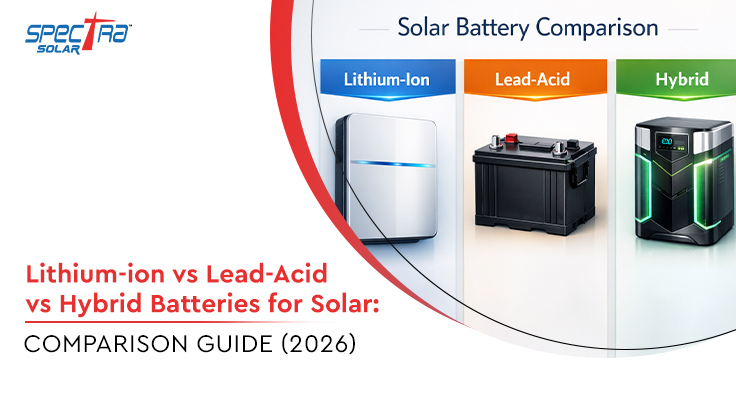
Lithium-ion vs Lead-Acid vs Hybrid Batteries for Solar: Comparison Guide (2026)

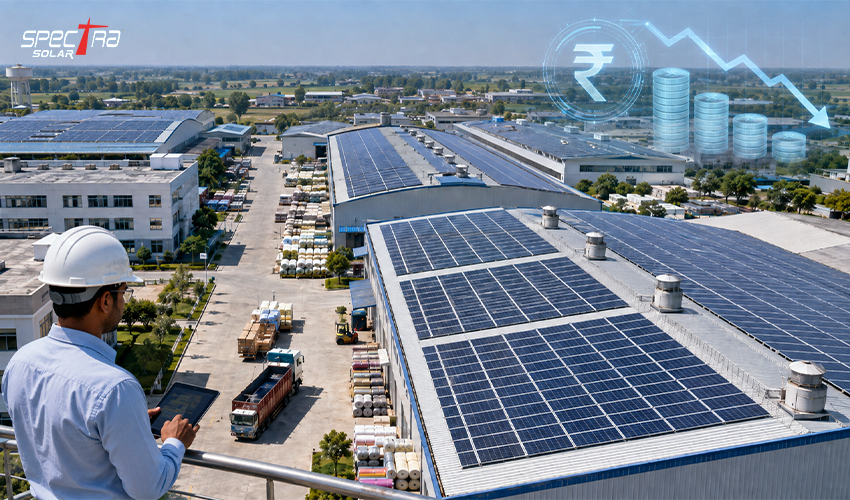
With India stepping on the gas to hit its bold green energy targets, families and local shops are cutting the cord with the grid for clean power at a blistering speed. Fresh data from the PIB (January 2026) shows India’s total power capacity has hit a massive 520.51 GW, with more than 39,000 MW of renewables plugged in over the last year alone.
But once you commit to installing solar panels for residential or industrial use, a practical headache remains: how do you store that power? The battery you pick today is basically a ten-year contract with your energy independence and your bank balance.
In this guide, we’ll move past the marketing fluff to break down the lead acid battery vs lithium ion battery debate, look at why Hybrid Batteries for Solar are suddenly everywhere, and help you navigate the 2026 energy market.
The Storage Evolution: Why Your Choice Actually Matters
Think of your solar setup like a professional kitchen. The panels are the stove—they do the hard work of generating the energy. But the battery is the refrigerator; it’s what keeps the "power" fresh and usable for later. If you pick a leaky, outdated fridge, you’re just throwing money away.
When weighing the lead acid vs lithium ion dilemma, you need to look at two specific technical metrics: "Round-Trip Efficiency" and "Depth of Discharge" (DoD). While a lead acid vs lithium ion battery comparison usually focuses on the upfront sticker price, the real story is in how much of that stored energy you can actually use before the unit starts dying. In 2026, when the average daily power supply in rural India has reached 22.6 hours, storage isn't just about surviving total blackouts; it’s about managing costs during the expensive peak hours.
1. Lead-Acid Batteries: The Traditional Workhorse
Lead-acid units have been the "Old Faithful" of the power world for decades. They’re familiar, easy to find, and usually offer the lowest upfront off-grid solar system price. However, in 2026, they’re starting to look like "feature phones" in a smartphone world—they work, but they’re extremely limited.
- The Good: Low entry cost; incredibly easy to recycle in most Indian cities, with recovery rates hitting 99% in organised sectors.
- The Bad: They’re massive, heavy, and demand regular solar panel maintenance services like distilled water top-ups every few months. Plus, they usually only last 3–5 years before needing a full replacement.
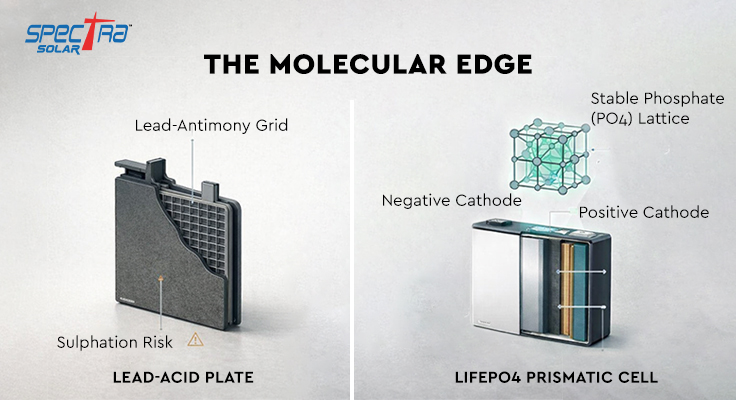
- The Efficiency Gap: A 2025 study on energy storage systems highlights a frustrating reality for lead-acid users: these units often hit a round-trip efficiency of just 78%. To put that in perspective, every time you charge your bank, nearly a quarter of that solar power vanishes. It doesn't reach your lights or fans; instead, it's wasted as internal heat and "friction" within the battery plates before it can ever be used.
- The 50% Rule: You can typically only use half of a lead-acid battery’s capacity. If you dip below that 50% threshold frequently, you are effectively killing the battery’s internal chemistry.
2. Lithium-ion Batteries: The Modern Gold Standard
If you’re hunting for the best solar panel company in India, you’ll notice they’ve almost entirely moved toward a lithium battery for solar panels as the default recommendation.
As we recently touched on while discussing strategies to maximise solar efficiency, these units are efficiency beasts, hitting 95–98%. For every 10 units you store, you get nearly all of it back. Despite a 2026 rebound in lithium carbonate prices to roughly $24,000 per metric ton, the total cost of ownership remains significantly lower than lead-acid due to sheer longevity.
- The Good: Tiny footprint; zero maintenance; a solid 10–15 year lifespan.
- The Cost: Yes, the initial off-grid solar system price is higher, often double that of lead-acid.
- Cycle Life: Industry data for 2026 shows that while lead-acid delivers 300–500 cycles, lithium-ion batteries (specifically LFP) offer between 3,000 to 6,000+ cycles even at a high depth of discharge.
- The DoD Edge: Most lithium units let you use 90% or even 100% of the capacity safely. This means you get double the usable power from the same rated capacity compared to a lead-acid counterpart.
3. Hybrid Batteries for Solar: The Smart Play?
A solar hybrid battery isn’t just a storage tank; it’s an intelligent energy manager. In 2026, Hybrid Batteries for Solar are becoming the standard for commercial solar rooftop systems because they play both sides—grid savings and off-grid backup.
These systems handle "Time-of-Use" (ToU) billing automatically. They "know" exactly when to charge from the sun, when to run the building, and when to sell excess power back to the grid. This is the only logical way to go if you’re figuring out how to choose a battery for solar panel setups that won’t be obsolete in three years.
The Money Side: Solar Billing & Net Metering
Picking a battery is as much a financial decision as a technical one. Homeowners often get confused by the technicalities of "what is Solar Billing?" or "what is Net metering?"
If you’re looking at an on-grid solar system price, you’re probably after Net metering, where you trade excess power for bill credits. Modern 2026 guidelines for Indian DISCOMs suggest that while credit policies vary, Net metering remains the most lucrative model for residential savings. Under the Electricity (Rights of Consumers) Rules, DISCOMs are now legally required to activate these connections within 30 days of your application.
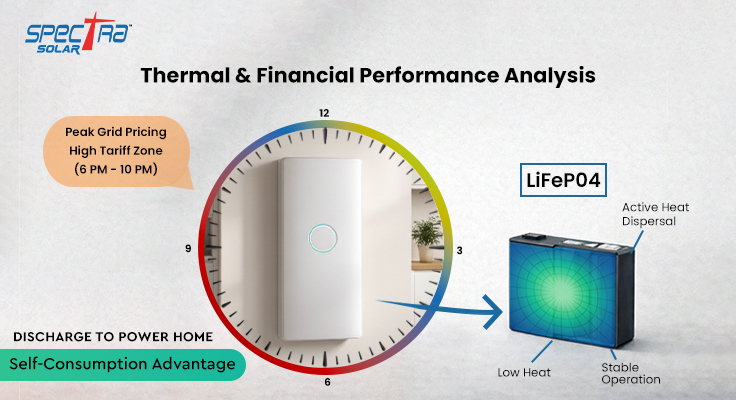
This is where a lithium battery for solar panels changes the math. Instead of selling your power for cheap during the day and buying it back at a premium at night, you just "self-consume" your own juice. It’s the easiest way to feel the benefits of using solar power without worrying about peak-hour tariffs.
Solar for Business: Heavy Duty Performance
In the solar panels for industry in India sector, there's absolutely no room for error. A factory can't have its production lines tripping because an old lead-acid bank decided to fluctuate during a heavy load start. Commercial solar rooftop systems now use high-voltage lithium racks that provide a steady, clean flow of power that protects expensive machinery.
When we calculate the on-grid solar system price for a business, we look at the 10-year Total Cost of Ownership (TCO). Engineering studies from early 2026 suggest that up to 20% of solar systems fail prematurely due to poor component matching. Lithium might cost more on Day 1, but when you realise you don't have to replace the entire bank every three years or hire someone for constant solar panel maintenance services, it becomes the obvious winner.
For a typical 1 MW solar plant, costing ₹3.5–₹5 crore in India, adding lithium storage can slash the payback period to just 4–5 years. This strategy bypasses heavy industrial tariffs—ranging from ₹7–₹14 per unit in states like Maharashtra or Karnataka, by utilising your own stored power.
Looking Ahead: Environmental and Safety Standards
By 2026, staying "green" is a legal mandate, not just a marketing slogan. Traditional lead-acid units are packed with nasty heavy metals like lead and mercury, demanding airtight, specialised storage to stop leaks. On the flip side, LFP (LiFePO4) setups are non-toxic and fit perfectly into a circular economy because they’re so easy to recycle.
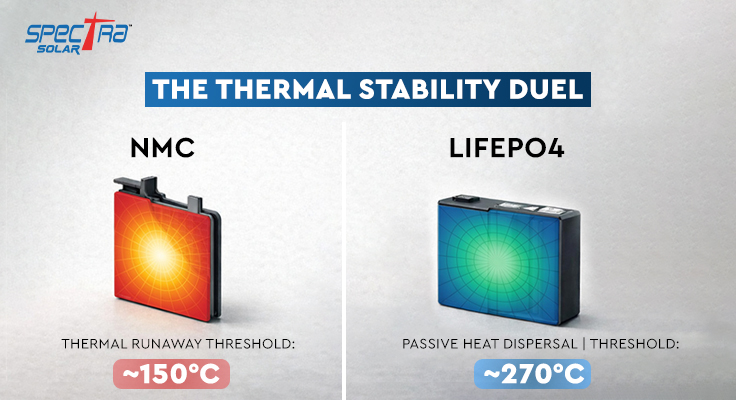
Safety is the real clincher here. Hard data shows LFP cells don't hit thermal runaway until they reach 270–300°C, while standard NMC lithium can catch fire at a mere 150°C. In the sweltering Indian heat, where rooftops can practically bake an egg, that 150-degree buffer is a literal lifesaver for residential solar owners.
Furthermore, with the introduction of Virtual Net Metering in states like Delhi and Karnataka, urban apartment dwellers can finally share a single massive lithium storage system across an entire building. This ensures that even those without individual roof access can reap the benefits of using solar power through proportional billing credits.
By leveraging high-end storage, businesses can also qualify for advanced sustainability certifications that attract eco-conscious investors and partners. The shift to lithium isn't just about the battery; it's about building a modern energy infrastructure that respects both the environment and your bottom line.
Conclusion: Making the Right Call with Spectra Solar
Whether you go for lead acid vs lithium ion or a solar hybrid battery really depends on your lifestyle. If you’re in a remote spot with 8-hour power cuts, you need a massive off-grid bank. If you're in a metro like Pune or Gurgaon, a hybrid system that juggles Net metering is probably your best bet.
At Spectra Solar Power, we focus on high-efficiency solar panels for residential and industrial use, paired with LiFePO4 tech that actually lasts. We believe the best solar panel company in India shouldn't just drop off a box of panels; we should give you a real path to zeroing out those bills.
Whether it’s a competitive on-grid solar system price or a rugged off-grid solar system price you're after, we’ll help you build something that pays for itself. Let’s make India’s rooftops work harder.

Share This Article


Ready to switch to solar?
Get a free site assessment and no-obligation proposal within 48 hours. Our team covers 100+ cities across India.
-
 Plot No. 2, Landmark Tower, 2nd Floor, South City-1, Ashok Marg, Gurugram, 122001, Haryana
 -

-

RELATED BLOGS