Solar for Textile Parks in UP: A Complete EPC and Cost-Savings Guide for Mill Owners

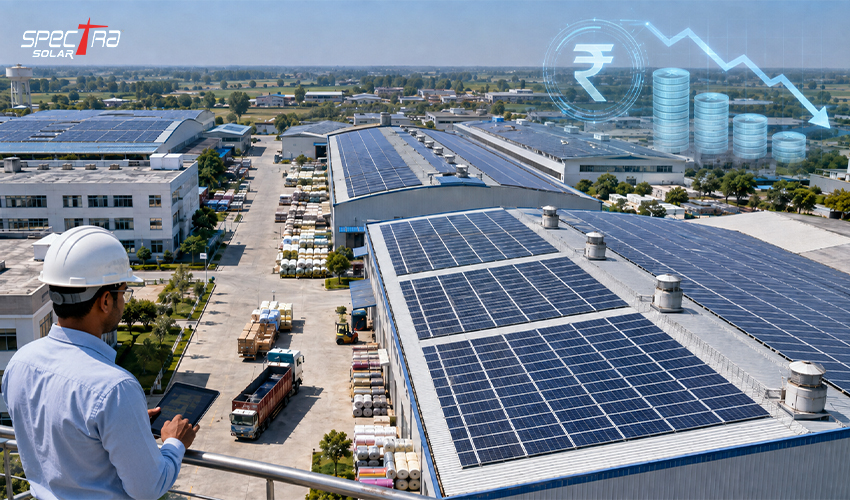
Textile mills run some of the highest, steadiest daytime power loads of any industry, spinning frames, looms, dyeing units, compressors, all pulling load through the exact hours solar generates the most. That overlap is a big part of why solar's showing up across UP's textile belt now, from Kanpur to the new PM MITRA park coming up near Lucknow. This guide walks through why the shift is happening, what an EPC contract actually involves, and how to pick the right partner for a mill-scale project.
Why Are Textile Parks in UP Switching to Solar?
UP's textile mills are moving to solar in 2026 mostly because the timing lines up, spinning, weaving and dyeing loads run through the day, the same hours solar actually generates. State textile policy's been overlapping with solar-friendly infrastructure lately too, and commercial and industrial solar pays back in 3-4 years once you factor in accelerated depreciation and lower per-unit costs. An EPC partner, Engineering, Procurement, Construction, just means one contractor handles the whole thing, design, sourcing equipment, installation, so a mill owner isn't stuck juggling three different vendors.
Key Takeaways
-
Rooftop solar typically cuts a textile mill's electricity costs by 30-70%, paying back in 3-5 years.
-
Commercial solar plants get 40% accelerated depreciation in year one under Section 32 of the Income Tax Act.
-
The new PM MITRA textile park coming up near Lucknow-Hardoi has solar baked into the infrastructure from day one, not bolted on later.
-
Installed cost runs around ₹35-50 a watt in 2026, with CAPEX systems paying back in 3-5 years against industrial DISCOM rates.
-
Picking the right EPC partner matters more here than in most industries, a power quality slip can disrupt spinning or dyeing machinery mid-cycle.
Why Textile Parks in UP Are Shifting to Solar Power in 2026
Textile parks in UP are shifting to solar because the sector's daytime-heavy load profile lines up almost perfectly with solar generation, and because new state textile infrastructure is being built with solar as a default rather than an afterthought.
The load-match advantage
Spinning, weaving and dyeing all run through the day, which means a mill's peak consumption hours overlap directly with peak solar output. That's a much better fit than industries with heavy night-shift or seasonal loads, where a big chunk of solar generation would go unused.
New infrastructure is being built solar-ready
UP's PM MITRA integrated textile park is coming up on 1,000 acres near Lucknow-Hardoi, and modern MITRA parks nationally are being designed around sustainable infrastructure, solar power, water recycling, zero liquid discharge, as standard features rather than optional add-ons. UP's textile hubs stretch well beyond Kanpur too, Varanasi and Mau for silk, Bhadohi for carpets, Bareilly and Shahjahanpur for zari-zardozi, and most of these clusters run on the same daytime-heavy load pattern that makes solar work.
Policy incentives are stacking up
The Uttar Pradesh Textile and Garmenting Policy 2022 already offers stamp duty exemptions for units in MITRA parks and private textile parks, and mills layering solar tax benefits on top of that policy environment end up with a meaningfully lower total cost of setting up or expanding.

How to Choose the Right Solar EPC Company for Your Textile Park
Choosing the right EPC company for a textile mill comes down to experience with industrial-scale power quality, ALMM compliance, and DISCOM coordination, since a mill's continuous machinery load has less tolerance for a poorly designed system than a typical commercial rooftop would.
A few things worth checking before signing anything:
Experience with industrial-scale loads, not just rooftop basics.
Textile mills reducing energy costs by over 30% is a common outcome, but only when the EPC actually sizes the system against real daytime demand data, not a generic template built for office buildings.
Power quality expertise.
Voltage fluctuations or a badly synced inverter can disrupt spinning or dyeing machinery mid-run, which means lost raw material and downtime. An EPC that understands grid-tied inverter synchronization for continuous industrial loads matters more here than it would for, say, a warehouse.
A track record on compliance paperwork.
ALMM listing, DISCOM approvals, net metering, and (where relevant) DCR compliance all need to be handled correctly the first time. Working with an established solar EPC company in India that's already done this for industrial clients avoids the back-and-forth that stalls out projects handled by less experienced vendors.
Tax and subsidy know-how.
Accelerated depreciation, GST input tax credit, and state-level incentives like UP's electricity duty exemptions for renewable generation only pay off if someone on the project actually knows how to claim them. A good EPC partner, or one working alongside your accountant, should flag these rather than leaving the mill owner to find out after the fact.
Understanding EPC: What "Engineering, Procurement, Construction" Means for Mill Owners
EPC means a single contractor handles the entire solar project, engineering the system design, procuring the panels and equipment, and constructing the installation, so a mill owner deals with one accountable partner instead of juggling a designer, a supplier and an installer separately.
Breaking down what each piece actually covers for a textile mill specifically:
-
Engineering: starts with a load audit, pulling 12 months of electricity bills and DISCOM demand data to identify how much of the mill's consumption happens during daylight hours, that's the "solarisable" load the system gets sized around. From there, the EPC maps roof area, shading, and structural capacity, since a 100 kW system typically needs somewhere around 8,000 to 10,000 square feet of usable roof.
-
Procurement: covers sourcing the actual hardware, panels, inverters, mounting structures, cabling, all rated for the specific conditions of a textile mill environment, which can include dust, heat, and sometimes chemical exposure near dyeing units.
-
Construction: is the installation itself plus commissioning, getting the system physically built, tested, and synced with the grid through DISCOM approval and net metering.

What It Actually Costs, and What Comes Back
|
Factor |
Typical Range (2026) |
|
Installed cost |
₹35-50 per watt, depending on system size |
|
Electricity cost reduction |
30-70% depending on current tariff and load match |
|
Payback period |
3-5 years |
|
Year-one tax benefit |
40% accelerated depreciation under Section 32 |
|
Additional benefits |
GST Input Tax Credit, UP electricity duty exemptions on renewable generation |
Locking in a captive solar plant also protects against something mills deal with every year regardless of solar, rising DISCOM tariffs. A system installed now effectively fixes a large chunk of your per-unit power cost for the next two and a half decades, while everyone still buying purely off the grid keeps absorbing whatever the next tariff revision brings.
Where Spectra Fits In
Spectra Solar Power works with textile mills and industrial facilities across Uttar Pradesh on industrial solar EPC company projects, from load audits and system design through ALMM-compliant procurement, DISCOM coordination and commissioning.
For mill owners weighing accelerated depreciation, GST ITC, or state-specific incentives alongside solar power for factory installation, the goal is handling the technical and compliance side end to end, including guidance through options like the MSME solar subsidy and tax benefit landscape, so mill owners aren't chasing that information separately.
Get in touch with Spectra Solar Power for a free site assessment and see what solar for textile mills would actually look like for your operation, from load sizing through to projected payback.
Frequently Asked Questions
1. How much roof space does a textile mill need for a meaningful solar installation?
Roughly 8,000 to 10,000 square feet of shadow-free roof or ground space per 100 kW of system capacity, depending on panel efficiency.
2. Can heavy textile machinery, spinning, weaving, dyeing, run on solar without disruption?
Yes, a properly designed grid-tied system synchronizes with the DISCOM grid, so sudden load surges from heavy machinery get supported by grid power automatically without disrupting production.
3. What tax benefits apply to a textile mill's solar investment?
Commercial solar installations qualify for 40% accelerated depreciation in the first year under Section 32 of the Income Tax Act, along with GST Input Tax Credit where applicable and, in UP, electricity duty exemptions on renewable generation.
4. Is solar worth it for a mill that already has diesel backup?
Usually yes, solar displaces the expensive daytime grid or diesel units your mill is currently paying for, and most mills see payback well within 5 years even without touching backup power costs.
5. What's the difference between choosing an EPC company and buying equipment separately?
An EPC company handles design, procurement and installation as one accountable contract, versus sourcing panels, hiring an installer and managing compliance separately, which is where most delays and cost overruns happen on industrial projects.
6. Does UP have specific incentives for textile parks going solar?
UP's Textile and Garmenting Policy 2022 offers stamp duty exemptions for units in MITRA parks and private textile parks, and new integrated textile parks like the one near Lucknow-Hardoi are being designed with sustainable infrastructure, including solar, built in from the start.

Share This Article


Ready to switch to solar?
Get a free site assessment and no-obligation proposal within 48 hours. Our team covers 100+ cities across India.
-
 Plot No. 2, Landmark Tower, 2nd Floor, South City-1, Ashok Marg, Gurugram, 122001, Haryana
 -

-


