Why Every Factory Owner Should Lock In Solar Before the DCR Price Shift

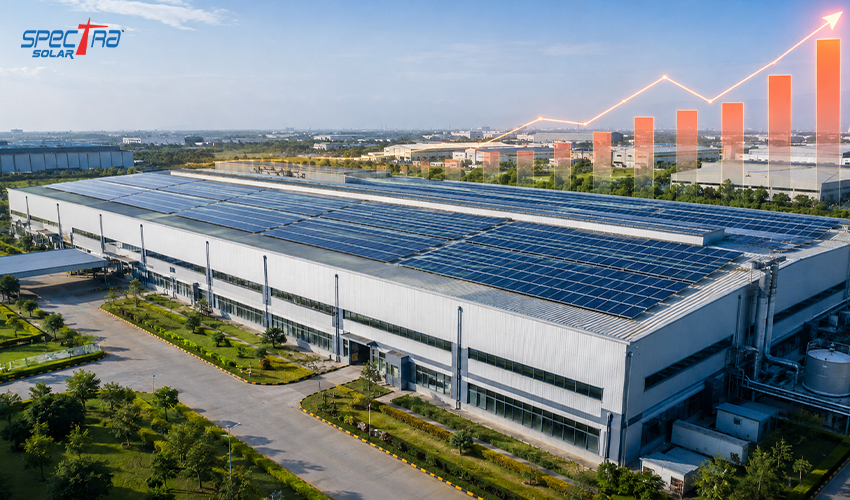
Factories that lock in industrial solar solutions now are paying a different price than the ones who wait until later this year. The reason's a regulatory shift most owners haven't fully clocked yet, tightening Domestic Content Requirement rules that are pushing panel costs up fast, and squeezing the supply of compliant equipment at the same time. Whoever moves first gets today's pricing. Everyone else is betting on a supply crunch sorting itself out on its own timeline.
What's the DCR Price Shift, and Why Should Factory Owners Care?
The DCR price shift refers to India's tightening Domestic Content Requirement rules, tied to ALMM List-II cell compliance, which became mandatory from June 1, 2026 for net-metered, open-access and subsidy-linked solar projects. Since most factory rooftop installations use net metering to export surplus power, this pulls the majority of solar for factories into the mandate, pushing module costs up by roughly ₹8,000 to ₹11,000 per kW compared to non-compliant imports.
Key Takeaways
-
ALMM List-II, the domestic solar cell requirement, became mandatory June 1, 2026 for government tenders, subsidy-linked projects, and any installation using net metering or open access.
-
DCR-compliant modules are currently running about ₹8 to ₹11 more per watt than non-DCR imports, translating to roughly ₹8,000-11,000 extra per kW.
-
Most factory rooftop solar uses net metering to sell back surplus generation, which means most industrial installations fall inside the mandate, not outside it.
-
Domestic cell manufacturing capacity is still catching up to demand, and industry estimates put open-access and net-metered demand growing from about 15 GW to 25 GW a year through 2026.
-
Locking in a project now, before your specific installation gets swept fully into compliance timelines, protects your budget from a cost curve that's moving in one direction.
What Is the DCR Price Shift?
The DCR price shift is the cost increase factories are seeing as India's Domestic Content Requirement rules tighten around which solar cells and modules qualify for grid connection, subsidies and net metering. It's tied specifically to ALMM List-II, the government's approved list for domestically manufactured solar cells, which became a hard requirement from June 1, 2026 for a wide set of project categories.
What's actually covered
Government tenders, PM Surya Ghar-linked residential systems, PM-KUSUM Components B and C, and anything using open access or net metering, which covers most industrial rooftop solar projects designed to export surplus power back to the grid, all fall inside the mandate.
What's still exempt
Here's where a lot of the confusion online comes from, this isn't a blanket ban on every non-DCR panel in the country. anchor textPurely private, behind-the-meter industrial systems with no subsidy claim, no open access, and no net metering can technically still use non-DCR modules. But that's a narrow carve-out, most factory rooftop solar doesn't fit it.

How Will the DCR Price Shift Affect Factory Owners?
Factory owners installing rooftop or captive solar with net metering will see higher per-watt costs as DCR-compliant modules become the only compliant option, since domestic cell manufacturing hasn't fully caught up to the sudden jump in demand.
-
Higher module costs: As of 2026, DCR modules are running roughly ₹8 to ₹11 more per watt than non-DCR imports, a gap that adds up fast at industrial scale.
-
Scale impact on a 1 MW system: That gap alone can mean an extra ₹80 lakh to ₹1.1 crore in module costs compared to what the same project would have cost on imported cells before the mandate tightened.
-
Demand outpacing supply: The pressure isn't easing off quickly either. Industry estimates put open-access and net-metered demand for DCR modules climbing from around 15 GW a year to 25 GW a year through 2026, as more commercial and industrial projects get pulled into compliance timelines. More demand chasing a supply base that's still scaling up usually doesn't end in lower prices.
|
Factor |
Locking In Now |
Waiting |
|
Module pricing |
Closer to current ₹8-11/watt DCR premium |
Exposed to further price increases as demand climbs |
|
EPC contract terms |
Negotiated ahead of peak demand |
Competing with a larger pool of delayed projects |
|
Compliant supply |
Easier sourcing while capacity keeps pace |
Longer lead times as certified capacity gets stretched |
|
Budget predictability |
Locked into a known CapEx figure |
Exposed to whatever the market looks like when you finally commit |
How Factory Owners Can Reduce Electricity Costs with Solar
The most direct way factory owners cut electricity costs with solar is by locking in project pricing and EPC contracts now, before further demand growth pushes DCR module costs higher, then letting the system offset daytime industrial load that would otherwise be drawn from an increasingly expensive grid connection.

There's also a practical compliance angle here that's easy to miss.
Compliance risk if you wait.
Factories that source ALMM-compliant equipment through an established solar EPC company in India don't just avoid the immediate price hit, they avoid future rework too. A system installed on non-compliant modules today risks running into approval friction if the plant later wants to add net metering, apply for a subsidy-linked expansion, or if state-level rules narrow that private-behind-the-meter carve-out further, which several signals suggest is a real possibility over the next few years.
What an EPC partner actually handles.
Working with a solar EPC company that already understands ALMM compliance, DISCOM approvals, and net metering paperwork removes most of that risk from the factory owner's side entirely. Rather than trying to track shifting cell manufacturing capacity and compliance deadlines in-house, the EPC partner handles procurement, compliance certifications, and installation as one package.
Why Locking In Now Actually Matters
The core issue isn't that DCR is a bad policy, it's a deliberate push toward domestic manufacturing and long-term supply security. The issue is timing. Domestic cell capacity is still ramping up to meet a demand curve that's climbing fast, and every month that gap persists, pricing reflects it. Factories that commit to a project now lock in today's module costs and EPC rates. Factories that wait are betting that capacity catches up to demand faster than it has so far, which isn't a bet the numbers currently support.
Spectra Solar Power works with manufacturing units, factories and industrial facilities across India on ALMM-compliant industrial solar solutions, handling site assessment, procurement, DISCOM coordination and net metering approvals as a single EPC engagement. As a solar company that's already sourcing compliant equipment at scale, the goal is getting factory owners into a locked project before further demand growth pushes costs up again.
Get in touch with Spectra Solar Power for a free industrial site assessment and lock in your project pricing before the next round of demand catches up to supply.
Frequently Asked Questions
1. Does the DCR mandate apply to every factory installing solar?
Not literally every one. Purely private, behind-the-meter systems with no subsidy, no open access and no net metering are technically exempt right now. But most factory rooftop solar uses net metering to export surplus, which puts it inside the mandate.
2. How much more expensive are DCR-compliant panels right now?
Roughly ₹8 to ₹11 more per watt than non-DCR imports as of 2026, which works out to about ₹8,000-11,000 extra per kW on a typical industrial installation.
3. Will DCR module prices come back down?
Possibly, as domestic cell manufacturing capacity scales up. But demand for DCR modules is currently growing faster than that capacity, from around 15 GW to 25 GW a year, so near-term relief isn't guaranteed.
4. What happens if I install non-DCR panels now and later need net metering?
You'd likely run into compliance issues trying to add net metering or apply for subsidy-linked benefits on a system built with non-compliant modules, since those categories fall under the mandate.
5. Is it worth locking in an EPC contract before starting construction?
Generally yes, locking in pricing and procurement now protects your project from further cost increases as demand for compliant modules keeps climbing through 2026.
6. Can an EPC partner handle DCR compliance for me?
Yes, an experienced industrial EPC partner sources ALMM-compliant equipment, manages DISCOM approvals, and handles the certification process as part of the project, so factory owners don't have to track shifting compliance rules themselves.

Share This Article


Ready to switch to solar?
Get a free site assessment and no-obligation proposal within 48 hours. Our team covers 100+ cities across India.
-
 Plot No. 2, Landmark Tower, 2nd Floor, South City-1, Ashok Marg, Gurugram, 122001, Haryana
 -

-


