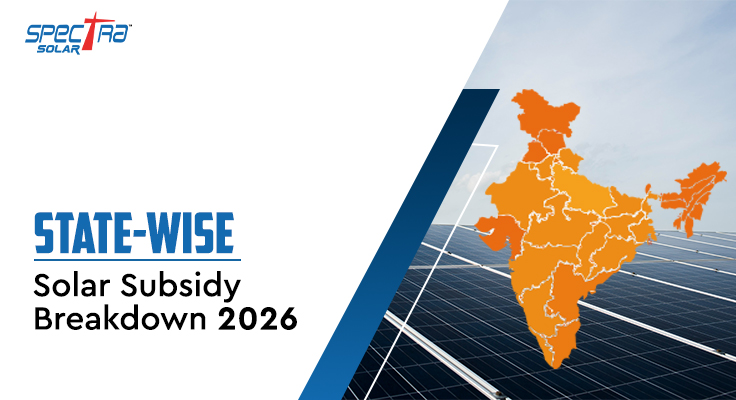
State-Wise Solar Subsidy Breakdown 2026

Switching to a residential solar setup is one of the most practical, forward-thinking financial moves an Indian homeowner can make in 2026. As conventional domestic electricity tariffs steadily rise across electricity distribution companies, investing in decentralised green energy offers an immediate fix for high utility expenses. It provides your home with decades of predictable, inflation-proof electricity generation.
Historically, the initial capital outlay required to buy premium photovoltaic hardware made many suburban families hesitate. Today, the economic landscape is completely different. By combining streamlined national grant from schemes like PM Surya Ghar Muft Bijli Yojana and with custom state-level financial top-ups, the central & state-wise subsidy on solar systems in India 2026 structure reduces upfront equipment and installation costs to historic lows.
However, navigating differing regional grid regulations, local net-metering timelines, and specific utility application windows can feel overwhelming. This breakdown deconstructs the state-wise solar subsidy 2026 framework. Read on to see exactly how much money your home can save, how the application approval pipeline works, and what to expect in major growth hubs like Pune, Lucknow, and Jaipur.
Understanding the 2026 Central Solar Subsidy Framework (PM Surya Ghar Muft Bijli Yojana)
The foundation of every domestic clean energy incentive in the country is the Solar panel subsidy in India 2026, managed centrally. This unified central framework removed old, fluctuating benchmark pricing rules. It replaced them with a direct, predictable Central Financial Assistance (CFA) payment scale.
The cash grant moves through an automated Direct Benefit Transfer (DBT) network, depositing funds straight into the homeowner’s verified, Aadhaar-linked bank account without any administrative delays. The 2026 central financial relief metrics explicitly focus on standard residential rooftop system sizes:
- 1 kW Systems: A flat, guaranteed national incentive of ₹30,000.
- 2 kW Systems: A flat, guaranteed national incentive of ₹60,000 (calculated at ₹30,000 per kW).
- 3 kW to 10 kW Systems: A fixed, maximum central incentive of ₹78,000. This is calculated as ₹30,000 per kW for the initial 2 kW, plus ₹18,000 for the third kilowatt.
While residential properties can install configurations up to 10 kW under standard net-metering rules, the central direct cash grant stays capped at a maximum of ₹78,000. Beyond the direct cash assistance, this scheme integrates with your local utility network to provide up to 300 units of free power every single month by balancing your personal solar generation with grid consumption.

Step-by-Step Regional Breakdown: Rooftop Solar Subsidy State-Wise
While the central government’s CFA remains the same regardless of your location, regional regulations create distinct differences in overall project costs. Multiple proactive state green energy agencies provide exclusive financial top-ups that stack directly on top of the standard central ₹78,000 grant. Here is how the rooftop solar subsidy state-wise framework scales across key regional markets.
1. Maharashtra: Accelerating Solar Subsidy in 2026
Maharashtra is easily leading the way when it comes to bringing solar into city homes. Right now, state officials and MSEDCL are working closely together to make setting up these domestic rooftop systems much cheaper for the average family.
- State-Level Top-Up Details: Local policy framework provides an exclusive regional bonus of ₹10,000 per kW for domestic setups. This cash extension maxes out at a total of ₹20,000 for configurations rated at 2 kW or higher.
- Total Financial Assistance: A domestic property owner commissioning a standard 3 kW system secures the nationwide central assistance grant of ₹78,000, piled with the regional state top-up of ₹20,000, ensuring ₹98,000 in immediate financial returns.
Backed by this generous multi-tiered reward structure, moving forward with an expert, code-compliant solar installation in Pune ensures highly optimised long-term fiscal returns. Homeowners across the urban sector can confidently expect to completely recoup their out-of-pocket investment within roughly three and a half years of activation.
2. Uttar Pradesh: Exploring Solar Subsidy in 2026
The Uttar Pradesh New and Renewable Energy Development Agency (UPNEDA) has thoroughly modernised the regional landscape for clean energy transitions. In a dedicated effort to turn metropolitan residential properties into fully decentralised power producers, the state provides one of the most compelling top-up programmes anywhere in India.
- State-Level Top-Up Details: Uttar Pradesh awards an additional, flat state-backed grant of ₹15,000 per kW, which is securely capped at a maximum residential property limit of ₹30,000.
- Total Financial Assistance: The stacked reward matrix offers truly immense financial relief. Setting up a standard 3 kW household setup allows you to merge the standard central baseline of ₹78,000 with UPNEDA’s ₹30,000 state bonus for an impressive ₹1,08,000 in total subsidies.
Driven by this massive injection of public funding, assessing the current market-wide solar panel price in Lucknow demonstrates that acquiring a home energy plant is far more accessible right now than it has ever been throughout the entire past decade.

3. Rajasthan: Securing Solar Subsidy in 2026
As India's leading state for raw solar generation capacity, Rajasthan takes a highly practical infrastructure approach. The state government does not add an independent direct cash bonus to the central subsidy, but it balances this by offering highly efficient utility processes.
- State-Level Top-Up Details: Rajasthan does not offer bonus cash payouts. Instead, JVVNL provides smooth online paperwork, fast tracking for net-meters, and immediate grid setup to keep things moving.
- Administrative Perks: Instead, JVVNL makes things easy by providing fast online approvals, quick net-meter setups, and hassle-free grid connections.
- Financial Impact: Getting an empanelled solar company in Jaipur to handle your project means skipping the red tape entirely and slashing your utility bills from month one.
Working with a certified solar company in Jaipur lets you skip annoying government paperwork and grid delays, meaning your system turns on fast, so you save money on your very next bill.
4. Delhi & Other Progressive Regions
Delhi remains an incredibly lucrative hub for residential rooftop installations. The state provides a dedicated local top-up of up to ₹30,000 alongside its popular Generation-Based Incentive (GBI), which pays homeowners up to ₹3.00 per unit of solar power produced. At the same time, states like Gujarat lead the country in total installed residential systems by combining standard national funding with fully automated, rapid-approval regional DISCOM portals.
The Technical "Catch": Unlocking Subsidies via DCR Compliance
To successfully claim your state-wise solar subsidy 2026 benefits, your project must comply fully with all technical rules set by MNRE (Ministry of New and Renewable Energy). The absolute most critical rule for receiving any residential government grant is the Domestic Content Requirement (DCR).
To get any of this government money, your system must follow a major rule: the panels have to be made right here in India. This means everything from the cells to the finished product is locally produced by a company on the official ALMM list. Skip this step, and you lose the grant.
If an installer uses imported components or non-ALMM solar panels, the national portal will automatically reject the application during engineering review, resulting in a total loss of your subsidy. High-efficiency local options, such as modern N-Type TOPCon and Mono PERC modules, are fully DCR-compliant. They allow you to claim the maximum ₹78,000 grant while ensuring excellent power generation during intense summer heat.
Step-by-Step Guide to Applying for Solar Subsidies in 2026
The national grid has removed confusing paperwork and third-party middlemen by transitioning the entire approval process to the official central rooftop solar website. The setup moves through six straightforward stages:
- Portal Registration: Create an account on the PM Surya Ghar national portal using your exact utility bill consumer number, an active mobile number, an email address, and your specific local electricity distribution company (DISCOM).
- Feasibility Analysis: Log in to your dashboard and submit a formal rooftop technical request. Your local DISCOM will review your local grid infrastructure and issue an official technical feasibility approval within 7 to 15 days.
- Choosing an Empanelled Partner: Finalise a commercial installation agreement with an MNRE-empanelled engineering provider. Registered solar firms manage all code compliance, perform precise load calculations, and upload structural details directly to the central registry.
- Installation and Documentation: After the panels are on your roof, your installer simply submits the final completion paperwork and photos straight to the official website to get everything approved.
- Net-Meter Commissioning: The DISCOM engineering team schedules an on-site inspection of your electrical work, checks safety shut-offs, and installs a bidirectional net meter.
- Direct Bank Transfer: Once the commissioning certificate is digitally approved on the portal, the verified central and state subsidy funds are released, appearing directly in your registered bank account within 30 to 45 business days.
Accelerate Your Clean Energy Transition with Spectra Solar Power
The financial returns offered by the state-wise solar subsidy 2026 framework make home solar plants an incredibly rewarding investment for Indian property owners. However, securing these maximum financial payouts requires technical precision, using fully verified DCR-compliant equipment, and coordinated handling of DISCOM inspections.
As an established, trusted name in renewable engineering, Spectra Solar Power provides comprehensive, stress-free rooftop solar transformations. From initial precise structural shade analysis and custom electrical design to managing every step of the central and state subsidy documentation, our team handles the heavy lifting. By installing only premium, ALMM-approved, high-efficiency domestic hardware, we ensure your system qualifies for the highest available government grants while providing dependable, zero-maintenance power for decades.
Rising power bills are a massive headache, but you can escape that trap by generating your own clean electricity. Reach out to Spectra Solar Power for an on-site survey today, and our engineers will show you exactly how cheap your monthly bills can get.

Share This Article


Ready to switch to solar?
Get a free site assessment and no-obligation proposal within 48 hours. Our team covers 100+ cities across India.
-
 Plot No. 2, Landmark Tower, 2nd Floor, South City-1, Ashok Marg, Gurugram, 122001, Haryana
 -

-

RELATED BLOGS