Solar for Dairy Farms & Poultry Units: The Hidden ₹40,000/Month Saving North Indian Agri-Businesses Are Missing
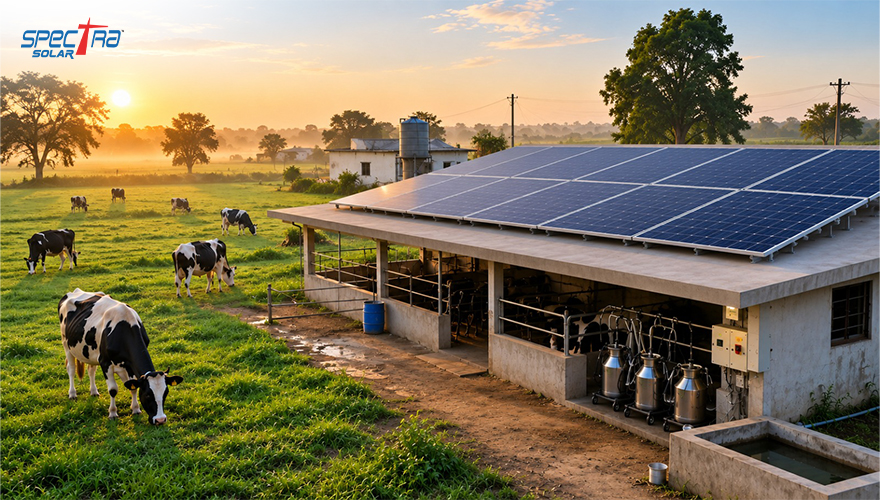
Managing a dairy or poultry unit in this part of the country is about keeping a tight grip on your margins because there is very little room for error. When your feed prices are already climbing, you start looking at every other expense twice. Electricity is usually the one that really bites. It is not just about paying the DISCOM bill every month; it is about the sheer amount of power you need just to keep the milking parlours, bulk coolers, and water pumps humming.
Then there is the headache of the grid itself. When the power goes, your only choice is the diesel generator. Running that thing for any length of time is a fast way to bleed cash—it is easily the most expensive way to power a farm. It feels like you are trapped in a loop where the money you should be putting back into the farm for growth is just going into fuel tanks and high utility tariffs. For many, that cost has become a massive bottleneck, effectively killing any chance of scaling up without the overheads spiralling out of control.
There is, however, a shift occurring. Progressive agri-business owners are discovering that transitioning to renewable energy is no longer just an environmental gesture; it is a financial strategy. By adopting solar for dairy farms in North India and solar for poultry farms in North India, operators are finding they can slash their monthly overheads, a shift supported by research into climate-resilient agriculture, effectively turning their roof space into a power-generating asset.
The Financial Reality of Agri-Energy Needs
Dairy and poultry units are essentially factories that never sleep. In a dairy setup, you are running milking parlours, bulk milk coolers, and water pumps around the clock; if the power drops, the production line and your product suffer. It is the same story in a poultry shed. You are managing ventilation, lighting, and climate control to keep the birds healthy, and if that power supply is inconsistent, the health of the flock takes a hit immediately.
When you look at how dairy farms save electricity with solar, the math is straightforward. Right now, most farm owners treat their monthly electricity bill as a tax on their business. By putting in a grid-tied or hybrid system, you are essentially pre-paying for your power. You lock in your energy rate for the next 25 years.
That hits two birds with one stone: you stop worrying about the grid’s unpredictable tariff hikes, and you stop relying on diesel generators. Between the cost of fuel and the constant maintenance those machines demand, a generator is the most expensive way to keep a farm running. Whether you are using solar for dairy farms in North India or solar for poultry farms in North India, you are moving your energy costs from a volatile monthly liability to a predictable, fixed asset.
|
Comparison Factor |
Traditional Grid or Diesel Power |
Spectra Solar Power System |
|
Monthly Operational Cost |
Fluctuating & Rising |
Fixed & Predictable |
|
Maintenance Frequency |
High (Diesel/Gen-Set) |
Low (Periodic cleaning) |
|
Reliability |
Susceptible to Power Cuts |
High (Backup & Storage) |
|
Long-term ROI |
None (Expense) |
3–5 Year Payback Period |
Why Solar is the New Standard for Agri-Business
Investing in solar energy for agri businesses in North India offers benefits that go beyond simple cost reduction. North India, with its abundant sunshine, is perfectly positioned to maximise the output of solar arrays.
-
Lowering the Daily Overhead: This is the most visible change. Once the panels are up, that monthly utility bill takes a significant hit. For a mid-sized operation, we frequently see monthly savings touch or exceed ₹40,000, depending on your connected load. It is a direct injection of cash back into your operational budget.
-
Keeping the Ventilation Running: In a poultry unit, power isn't just about lights; it’s about survival. A ventilation failure during a heatwave is a disaster. When you pair solar with battery storage, you build a safety net that keeps your fans spinning even when the grid gives up.
-
No Moving Parts to Fix: Compared to the engines and pumps you manage daily, solar is boring, in the best way possible. There are no moving parts to lubricate or fix. A solid system just needs a regular cleaning schedule to clear off the dust and a routine technical check every few months to make sure the electrical connections are tight.
Finding the Right Fit for Your Farm
Not every farm needs the same gear. The secret to a successful transition is choosing the right enterprise solar solutions in India for your specific reality. If you have a stable grid connection but hate the high per-unit cost, a standard commercial-grade grid-tied system usually does the job. However, if your farm is at the end of a long, tired line where the voltage dips whenever you turn on a heavy motor, an off-grid solar panel system for homes or farm buildings is a much smarter move to ensure you have power 24/7.
When you start talking to providers, be direct. Ask them specifically about their experience with commercial solar installation and ensure they are using industrial solar panels built for the North Indian plains. You need hardware that won't just work on day one, but can survive the intense heat, the gritty dust storms, and the extreme weather cycles that define our region.

The Role of Professional Installation
Quality is the difference between a high-performing asset and a liability. The best solar installation company in India will not just slap panels on a roof; they will perform a detailed energy audit, calculate the exact shadow analysis, and design a solar panel system for commercial buildings that aligns with your specific load profile.
Just as we have discussed the reliability of simple solar thermal solutions, professional photovoltaic installations are designed to provide consistent, long-term performance. Ensuring the structural integrity of your sheds and the efficiency of the inverters is paramount to achieving the projected savings. Our approach prioritises performance-driven engineering over simple capacity.
Understanding the Long-Term Agri-Business Impact
Moving to solar isn’t just about swapping one energy source for another; it is about changing how you handle your biggest overhead. In North India, seasonal power spikes are a reality of the business. When you rely solely on the grid, you are at the mercy of unpredictable load shedding and rising tariffs. A captive solar setup gives you the one thing that matters most: autonomy. You stop being a passive consumer of grid power and start becoming your own energy provider.
Look at how you handle heat stress in the poultry sheds. When summer hits, those cooling systems need to run flat-out. That is exactly when the local grid usually struggles, often leading to power cuts just when the birds need that air the most. You end up burning diesel in the backup generator, which is effectively burning money. Solar flips that dynamic. Your system hits its peak generation right when the sun is hottest, exactly when your cooling load is at its maximum. It is a natural hedge. The hotter it gets, the more power your roof produces.
It is the same for dairy units that are ready to scale. If you are moving from just collecting raw milk to handling your own chilling or pasteurisation, your power demand is going to jump. That is where the modular nature of solar becomes useful. You don’t have to guess what your power needs will be ten years from now.
You build for what you need today, and as your processing capacity grows, you add capacity to the array. By adding storage, you stop wasting the extra energy you make during the day and start using it to keep your milk chillers running through the night. It turns the farm into a self-contained operation that isn’t held back by the limitations of the local substation.
Sustainability as a Competitive Edge
Beyond the direct reduction in utility bills, there is an evolving conversation regarding the sustainability of agri-products. Large retailers and exporters are increasingly scrutinising the carbon footprint of their suppliers. Tier 1 supply chains are shifting towards a model where "clean production" is a prerequisite for long-term procurement contracts.
By adopting solar for dairy farms in North India and solar for poultry farms in North India, you are generating more than just kilowatts; you are generating verifiable environmental metrics. These data points can be integrated into your branding, providing you with a distinct advantage when negotiating with modern, eco-conscious distributors.
Why Technical Due Diligence Matters
The market is flooded with offers for budget installations, but solar is a 25-year investment. A commercial solar installation using inferior components will degrade faster, provide lower yields, and potentially increase fire risks—a hazard no poultry or dairy owner can afford.
When evaluating industrial solar panels, look for:
-
Tier-1 PV Modules: High efficiency and low degradation rates.
-
Robust Inverters: Superior MPPT (Maximum Power Point Tracking) technology to handle varying solar inputs.
-
Mounting Structures: Corrosion-resistant, wind-tested frames that can handle North India’s weather cycles.
Investing in high-quality systems ensures that the ₹40,000 monthly savings remain consistent over the decades rather than dwindling after a few years due to component failure.
Conclusion: A Smarter Way to Power Your Farm
Transitioning to solar isn't about chasing trends; it’s about plugging a hole in your profit margins. In this industry, your energy costs are one of the few variables you can actually lock down. When the grid fluctuates, or the tariff rates hike, the farm that has its own reliable power generation is the one that stays operational while the others scramble.
At Spectra Solar Power, we stop looking at roofs as just cover and start seeing them as the most underutilised asset on your property. We have spent years dealing with the realities of North Indian agricultural operations, the harsh summer heat, the unpredictable dust, and the very real need for consistent power in milking and climate-controlled sheds. We don’t just drop panels on a roof; we build systems designed to handle the specific load profiles of your machinery.
We have a simple approach: if we wouldn’t stake our own reputation on the durability of the installation, we won’t install it on yours. From the moment we walk your site for the initial audit to the final handover, our team is the one on the ground ensuring the work is done right.
If you are finished with watching utility bills cut into your bottom line, let’s look at the actual numbers. It’s time to move the conversation from "what-ifs" to a tangible plan that turns your roof into a steady power source.
Frequently Asked Questions
1. Is the maintenance going to be a headache?
Honestly, it’s straightforward. Panels are rugged by design, but North India’s dust is relentless. All you really need is a consistent cleaning schedule to keep the surface clear and a quick technical check every few months to make sure the wiring and inverters are healthy. It’s a small amount of work that protects your output.
2. What happens when the sky goes grey?
The system keeps working. Yes, you will see a drop in production compared to a clear, blistering summer afternoon, but your panels are still pulling energy. A well-designed system accounts for those grey days so that you aren't left in the dark the moment a cloud moves in.
3. How many years will this kit actually last?
Treat this as a permanent addition to your business infrastructure. The industrial-grade modules we spec for farms are engineered for a 25- to 30-year lifecycle. You are installing this to serve your farm for a generation, not just for the next few seasons.
4. Can I really run heavy gear off these panels?
We do it all the time. The bottleneck with heavy farm machinery is usually the "inrush current" or startup load of big motors. We bypass that by using the right scale of inverters and high-grade industrial components that can take that initial kick without tripping the system. If your milking machines, chillers, and pumps are sized correctly, the solar array handles them as part of the daily load.
5. Is there a realistic return on investment (ROI) timeframe?
For most agri-businesses in North India, the numbers are very favourable. Thanks to the significant reduction in monthly grid electricity bills, most farm owners find that their system pays for itself in savings within 3 to 5 years, leaving the remaining two decades of power as virtually free energy.

Share This Article


Ready to switch to solar?
Get a free site assessment and no-obligation proposal within 48 hours. Our team covers 100+ cities across India.
-
 Plot No. 2, Landmark Tower, 2nd Floor, South City-1, Ashok Marg, Gurugram, 122001, Haryana
 -

-


