What Are Half-Cut Solar Panels? Working, Types, Benefits, and Cost

The solar industry is always pushing for higher efficiency. Every major technical adjustment—a shift in cell material, or a structural change—sets a new industry standard. Right now, that technical evolution is the half-cut solar panel. This innovation is fundamentally changing how we approach power generation, especially for installations where roof space is limited or partial shading is an ongoing concern.
The immediate question people have is simple: Is this new tech worth the investment? Are half-cut solar panels worth it? To make a truly informed decision, you need the full picture. We’ll cover how they work. The different types of Half-Cut Solar Panels available, the real advantages of half-cut solar cells, and how the cost stacks up against traditional models. Let’s get stuck into the mechanics.
What Exactly are Half-Cut Solar Panels?
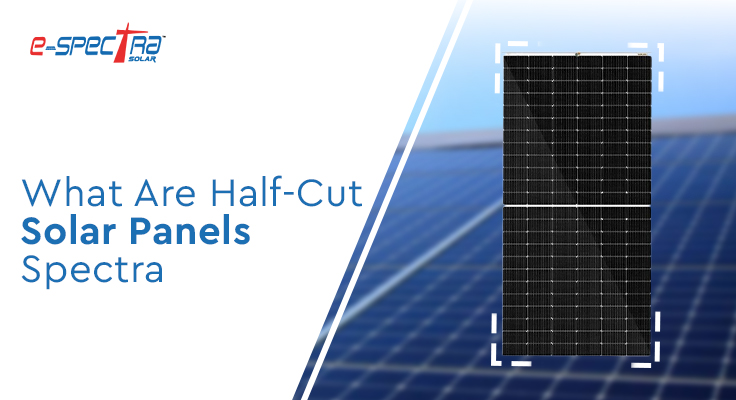
Forget exotic materials for a moment. A half-cut solar panel starts life as a standard-sized module. The crucial difference is in the process. Simple, really. The full solar cells—those bits that capture sunlight—are precisely cut in half. A high-precision laser does this. It ensures the cut is clean. No cell damage.
So, if a conventional module contains, say, 60 full cells, the half-cut version packs 120 half-sized cells. Same frame, double the bits. This isn't just dividing components, though. That physical cut mandates a totally different electrical wiring arrangement inside. This redesign? That is the secret sauce behind the performance gains.
How Does a Half-Cut Cell Solar Panel Actually Work?
The superior performance of the half-cut solar panel boils down to two things. A brilliant application of basic electrical physics. And, genuinely, a much smarter wiring design.
Less Current, Less Heat
In any electrical system, power is lost as heat. That's resistive loss. The physics rule is Ploss = I2R. Notice the current (I) is squared? That means the current size massively influences loss.
Here's the trick: when you slice a cell in half, the current (I) produced by each half-cell automatically halves. You halve the current. But because the loss is proportional to I2, the resistive heat loss drops by a whopping 75%. Less energy wasted as heat means more electricity reaches your system. Big boost, that is. Also, the panel runs cooler internally. This greatly improves its long-term performance stability, a massive deal in India’s high temperatures.
Superior Shade Tolerance
Traditional panels often wire their cells in three long series strings. That's a huge weak point. If a small shadow—a leaf, a bird dropping—lands on just one cell, the entire chain can fail. That tiny obstruction can kill one-third of the panel's output instantly. It’s deeply inefficient.
The half-cut solar panel design cleverly avoids this. The panel is electrically split down the middle. You get two entirely independent working halves (top and bottom), wired in parallel. In the real world? If the bottom half is shaded, the top half keeps producing power at full capacity. You lose only half the module’s generation, not potentially two-thirds. This makes the half-cut solar panel incredibly robust against everyday partial shading.
Understanding the Types of Half-Cut Solar Panels

The half-cut slicing process is a design evolution. It enhances any underlying cell technology. The most common and effective models today are worth knowing:
- Mono PERC Half-Cut Cell Solar Panels: This is the industry standard. Trusted. Reliable. It combines Monocrystalline cells (high quality, uniform look) with PERC (Passivated Emitter and Rear Cell) technology. That PERC layer is simply a coating. It bounces escaping light back into the cell for a second shot at conversion. These modules offer high efficiency (often over 21%). A solid choice when maximising energy output from limited space is key.
- N-Type TOPCon Half-Cut Cell Solar Panels: This is the current cutting-edge. N-Type cells are inherently more stable. They resist common efficiency drops like Light Induced Degradation (LID). TOPCon (Tunnel Oxide Passivated Contact) is a refinement that further optimises power collection. They deliver higher overall efficiency. They excel in hot weather and offer superior longevity.
- Bifacial Half-Cut Solar Panels: These panels draw power from both the top and the bottom, using reflected light. Applying the half-cut design boosts this dual-sided energy capture. Highly effective for commercial or industrial flat roofs placed over reflective surfaces. They generate a 'bifacial gain'—a substantial extra percentage of power from reflected light.
The Clear Advantages of Half-Cut Solar Cells: Why Invest?
Choosing this technology is absolutely a strategic investment. The benefits are clear: a more durable asset. Superior long-term performance. And a faster financial return.
- Big Efficiency Boost: We established the main win: a dramatic reduction in heat loss. This makes the panel simply more effective at converting sunlight to power. You get a higher wattage rating from the same physical panel size. A modern half-cut module can easily deliver 450W or more.
- Unbeatable in the Shade: This is the single most compelling operational reason. Operating as two separate entities means that when one side is shaded, the other half continues generating full power. Your system stays productive all day.
- Hot Spot Protection and Durability: Hot spots—areas of dangerous overheating—are less likely. Why? Because the cells carry half the current and run cooler. This lowered thermal and electrical strain enhances the lifespan.
- Better Low-Light Generation: The parallel connection allows the module to power up earlier at sunrise. Stay productive longer at sunset. It also helps maintain decent output on cloudy days.
- Handles Heat Better: Half-cut solar panels operate at a lower internal temperature. So, they show a better temperature coefficient. This makes them excellent for maintaining high energy yields in hot climates.
The Final Financial Check: Are Half-Cut Solar Panels Worth It?

When comparing solar technologies, everyone wants to know one thing: Does the higher performance translate into better savings?
A half-cut solar panel does have a slightly higher manufacturing cost—typically a minimal increase of 0.6% to 1.2%, due to the high-tech laser work and complex wiring. Fair enough. However, the true metric is the cost-per-watt and the value over its lifespan. Because these panels reliably generate 2% to 4% more power from the same footprint, the actual cost per unit of usable energy is lower. You need fewer physical panels to hit your target output.
This reduces costs for mounting hardware, wiring, and installation labour. It easily cancels out the slight price premium.The superior performance of the half-cut solar panel in real-world conditions means it simply churns out more kilowatt-hours (kWh) of electricity every year. This quicker, higher energy generation leads to a faster payback period for the entire system.
Partnering for Maximum Power Output
Understanding the technology is the first step. Installing it correctly is the second. For anyone looking to install a new system, whether it’s rooftop solar panels for homes or a large on-grid solar system in India, choosing the right partner ensures you fully benefit from these advancements.
We at Spectra Solar Power specialise in leveraging innovations like the half-cut solar panel to design robust off-grid solar systems and on-grid solutions. We provide expert advice, handle optimal system layout (crucial for dealing with shade), and offer full-spectrum Solar panel maintenance services to guarantee peak performance for decades.
Want to understand how different panel materials stack up against each other? Be sure to check out our detailed article: Monocrystalline vs. Polycrystalline: Which Panel is Right for Your Indian Home?

Share This Article


Ready to switch to solar?
Get a free site assessment and no-obligation proposal within 48 hours. Our team covers 100+ cities across India.
-
 Plot No. 2, Landmark Tower, 2nd Floor, South City-1, Ashok Marg, Gurugram, 122001, Haryana
 -

-

RELATED BLOGS