Solar Panel Cost for Home in 2026

To reduce expensive electricity bills, especially in the warmer months As people tend to use more heating and geyser appliances during the winter months, many Indian homes are researching the typical price of solar panels and deciding whether to install solar power on their roofs.
Homeowners wanting to Install Solar Panels should know the average cost of solar panels. The price of solar panels for your home can vary a lot depending on the size, quality of equipment, and installation requirements. However, as there are government subsidies available for qualifying households, the cost of solar panels for home installation can be significantly reduced.
Solar Panel Cost for Home Installation in India (2026)
Depending on the system size, panel type, inverter type, installation requirements and government subsidies, you can see a large range in solar panel pricing. Whilst a 10kW system will be much more expensive than a 1kW system, the final quoted price may not be fully representative of the installation cost.
A full system price for solar panels should include all necessary components, installation framework, wiring and labour. We have outlined below the estimated price of solar panels, subsidies, and factors to consider in order to determine an accurate solar panel cost for home installation in India. At Spectra Solar Power, we believe homeowners make better decisions when they understand the numbers instead of just trusting a quote, so we’ve tried to lay this out as plainly as possible.
Curious to know what your home's solar potential looks like? Explore the Solar Calculator Enter your details and explore what your rooftop could generate.
Solar Panel Cost for Home Installation in India
Although it is commonly assumed that the average cost of solar panels for homes ranges in price from ₹45,000 to ₹85,000 per kW, the overall solar for home price can vary depending on the quality of equipment, location and requirements.
Below shows estimated solar panel installation price in 2026. From this table, you can get an idea of the difference in solar panel prices with and without subsidy.
|
Capacity |
Estimated Total Cost (Pre-Subsidy) |
Government (Central) Subsidy |
Total Cost (Post-Subsidy) |
|
1kW |
₹70,000-₹1,05,000 |
₹30,000 |
₹40,000-₹75,000 |
|
2kW |
₹1.10-lakh to ₹1.70-lakh |
₹60,000 |
₹50,000-₹1.10-lakh |
|
3kW |
₹1.50-lakh to ₹2.25-lakh |
₹78,000 |
₹72,000-₹1.47-lakh |
|
4kW |
₹1.95-lakh to ₹2.85-lakh |
₹78,000 |
₹1.17-lakh to ₹2.07-lakh |
|
5kW |
₹2.40-lakh to ₹3.50-lakh |
₹78,000 |
₹1.62-lakh to ₹2.72-lakh |
|
6kW |
₹2.85-lakh to ₹4.10-lakh |
₹78,000 |
₹2.07-lakh to ₹3.32-lakh |
|
7kW |
₹3.30-lakh to ₹4.65-lakh |
₹78,000 |
₹2.52-lakh to ₹3.87-lakh |
|
8kW |
₹3.75-lakh to ₹5.20-lakh |
₹78,000 |
₹2.97-lakh to ₹4.42-lakh |
|
9kW |
₹4.20-lakh to ₹5.85-lakh |
₹78,000 |
₹3.42-lakh to ₹5.07-lakh |
|
10kW |
₹4.50-lakh to ₹6.50-lakh |
₹78,000 |
₹3.72-lakh to ₹5.72-lakh |

Notes:
Prices shown are indicative of prices for on-grid systems for homes. Prices may vary depending on the equipment, location and installation. Subsidies shown are indicative of the central subsidy available to qualifying residential customers in general category states. Subsidies may differ in special category states and UTs.
As you can see from the table, the maximum amount of central Government subsidy is given for solar systems 3kW and above. It is therefore very important to understand the government scheme to calculate an accurate solar panel cost for home installation and solar system for home price.
What Are the Eligibility, Subsidy Payment and Loan Options?
Eligible residential consumers can apply and implement the PM Surya Ghar scheme through the National Portal. Following implementation and verification by DISCOM, the consumer will be paid the approved government subsidy into either their bank or suitable loan account. Consumers can also access a solar loan from banks and financial institutions where they are unable to self finance the full cost of a residential solar installation. Consumers can receive the government subsidy, even if they have accessed a solar loan. Information regarding the government subsidy and the loan including interest rates and repayment period is subject to prevailing government and financial institution policy.
What is Included in Solar Panel Costs?
Understanding exactly what is included in the average cost of solar panels and installation price is important. The price of a complete solar system should include much more than just solar panels.
Typically, components in a complete solar system include:
-
Solar Panels – Convert sunlight to energy for the home. In India, the most common solar panel types are Mono PERC and TOPCon. Depending on which type of panel is used the solar panel cost for home can vary.
-
Solar Inverters – Convert energy from DC to AC so that it can be used in household appliances.
-
Solar Mounting Frame – Holds solar panels in place at the correct angle on your roof.
-
Wiring & Protection – Cables, connectors, earthing and protection equipment.
-
Installation & Commissioning – Labour, installation, testing and co-ordination to get your solar system up and running.
Depending on the conditions of your roof, lengthy cabling, or specialist mounting requirements, the solar panel installation cost for home can vary. If receiving a quote, ask for a breakdown of costs. A cheaper price could simply mean that certain components or services are missing compared to another quote. Comparing the full solar panel installation cost for home is therefore more useful.
How Many Panels Should I Install?
The size of solar you should install will depend on how much energy you consume in your household. Simply installing a popular system size may not be appropriate for your needs.
Below is general guide:
|
Capacity |
Appropriate Household |
|
1kW |
Low energy usage. |
|
2kW |
Small household with basic appliances. |
|
3kW |
Medium sized household with regular appliance use. |
|
5kW |
Large households with many high energy appliances. |
|
10kW |
Large homes/villas with high energy usage. |
As a general guide, 1kW of home solar panels on your roof will give you approximately 100-140 units of energy per month. The amount of energy you generate will depend on sunlight, location, panel angle, shading and system losses.
A 3kW system could produce 300-420 units per month. However, how much money you save from this will depend on when you use the energy, and what DISCOM rate you are paying.
To get a good idea of what system size you should install, it is a good idea to look at your electricity bill in recent months. This will give a much better indication of your expected average cost of solar panels and return on investment, rather than just looking at upfront solar for home cost.
Solar Panel Installation Cost by City (3kW System Example)
Prices for 3kW rooftop solar can differ from city-to-city. Factors such as the type of equipment used, installation needs, ease of access to your roof and servicing expenses will affect the price. Below is a general guide to initial costs in some Indian cities:
|
City |
Estimated Cost Before Subsidy |
Estimated Cost After ₹78,000 Central Subsidy |
|
₹2,20,000 |
₹1,42,000 |
|
|
Ahmedabad, Gujarat |
₹2,10,000 |
₹1,32,000 |
|
₹2,15,000 |
₹1,37,000 |
|
|
₹2,20,000 |
₹1,42,000 |
|
|
Hyderabad, Telangana |
₹2,15,000 |
₹1,37,000 |
|
Chennai, Tamil Nadu |
₹2,25,000 |
₹1,47,000 |
|
Bengaluru, Karnataka |
₹2,50,000 |
₹1,72,000 |
|
Delhi |
₹2,30,000 |
₹1,52,000 |
Note: These are sample indicative costs for domestic solar PV. Costs shown are after the usual central government subsidy given for a qualifying 3kW domestic system. Prices can also be affected by the type of system and installation circumstances. Furthermore, additional benefits may be available at state-government level. Qualifying for and being approved for subsidies is dependent on relevant program rules.
What affects the cost of solar panel installation?
Two people could both install identical sized solar systems, yet pay different amounts for these due to factors which include the technology, roof and installation involved. Below are the principle factors which can affect the cost of solar panel installation in India.
Size of system
Increasing system size will usually result in an increased cost. As well as having more solar panels, a larger system will typically need a bigger inverter and ancillary products. Although, the cost per kW may be affected by system and product type.
Type of solar panels
A variety of technologies are available for solar panels and the efficiency of these can also affect the cost. Although higher efficiency panels can be more expensive they can produce a greater amount of electricity in a given area. Appropriate consideration should be given to roof size, energy needs and budget when deciding upon the most suitable technology.
Inverter
An inverter is used to change the direct current (DC) electricity produced by solar panels into alternating current (AC) which is what is used by most appliances. The size, make, technology and facilities of an inverter can all affect the system cost. Typically, on-grid inverters are used for systems connected to the electricity grid. Hybrid inverters can be used with, as well as for, battery storage and for creating a back-up supply. Again, an inverter should be chosen to suit both the system and the homeowner’s needs.
Mounting
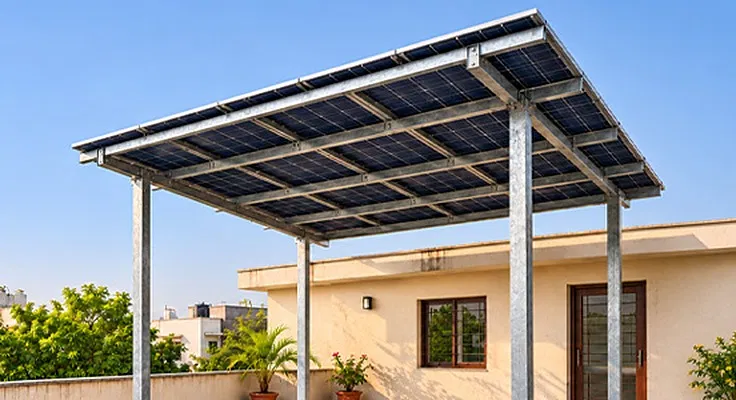
Appropriate mounting is crucial for the correct installation of solar panels. Factors such as the type, height and intricacy of the mounting system can affect its cost. Whereas a flat roof may necessitate one style of mounting, a pitched roof or other roofing material may need another. Furthermore, supplementary mounting and/or bespoke mounting can raise the installation cost.
Roof details and state
Both the design and state of a roof can influence installation costs. Usually, a flat concrete roof can be easily installed upon. However, properties with pitched roofs, metal shingles or otherwise hard-to-access roofs may need special mounting solutions and further work can be needed. Moreover, if roof repair, strengthening and/or waterproofing is necessary, then these can incur extra costs.
Location and installation
Depending on where someone lives, there can be variations in the cost of installation. These may stem from differences in delivery, local installer access, labour and ease of access to a property. Local climate and DISCOM stipulations can also affect system design and so cost. Therefore, in order to obtain the most accurate quote, it is advisable to seek out installers who are experienced in the area that someone lives in. Merely using national average costs may not be appropriate.
Type of solar system
There are several types of solar system which can be installed and each of these can affect the cost:
-
On-grid – This is connected to the electricity grid and typically does not have a back-up power supply. Often, this is a good value-for-money system for those whose property has good access to the electricity grid.
-
Off-grid – This operates without reference to the electricity grid and so must include battery storage. However, this can add to the initial installation costs.
-
Hybrid – This includes both grid and battery back-up. Although it provides more options, generally a hybrid system will be more costly as further items and batteries are involved.
Factors to take into account when deciding upon a system include energy usage, how often electricity supply is disrupted and roof space. Carrying out a survey and obtaining an in-depth quote can help somebody to ascertain the true cost of installing solar panels at their property.
Book your free site survey and get a panel quote built around your roof.
FAQs
1. What is the average cost of solar panels for homes in India?
The average solar panel cost for homes in India can range from around ₹45,000 to ₹85,000 per kW. The final solar panel cost can vary depending on the installation requirements and if you qualify for a subsidy.
2. How much does a 3kW solar system cost (with subsidy)?
A 3kW system can cost between ₹1.50L and ₹2.25L. With the central subsidy of ₹78,000, this price can be between ₹72,000 and ₹1.47L. This can give you an idea of the solar panel installation cost for homes.
3. Will I qualify for a subsidy with a 5kW system?
Yes. If you are a qualifying residential customer, you can qualify for central subsidies with a 5kW system. However, in general category states, you will still be limited in subsidy to a maximum of ₹78,000. The solar system for home price after subsidy will depend on the price of the installation initially.
4. Can solar panels be installed without batteries?
Yes. On-grid systems do not require batteries. If there isn’t enough solar production at the time, energy can be taken from the grid. However, with standard on-grid systems, backup is typically not provided during a blackout.
5. Do I need DCR panels in order to qualify for solar subsidies?
Yes. In order to qualify for PM Surya Ghar subsidies for residential solar installation, you must meet all of the criteria. This includes using DCR-compliant panels.
6. What is the Difference Between Solar Panel Cost and Installation Cost?
Solar panel cost is the price of the panels alone. Installation cost covers the full system: panels, inverter, mounting, protection, labour and commissioning. Always check that your quote covers the complete residential rooftop solar system.

Share This Article


Ready to switch to solar?
Get a free site assessment and no-obligation proposal within 48 hours. Our team covers 100+ cities across India.
-
 Plot No. 2, Landmark Tower, 2nd Floor, South City-1, Ashok Marg, Gurugram, 122001, Haryana
-

-