Solar Billing Explained: Credits, Units, and Savings

The "honeymoon phase" of rooftop solar in India is officially over, replaced by a much grittier reality: the administrative and technical struggle for every single kilowatt-hour. As of mid-2026, the blue silicon sea across millions of roofs is no longer just a symbol of sustainability—it is a live balance sheet where households are fighting to reconcile what their apps promise against what their DISCOM actually delivers.
If your dream of a "Zero Bill" has been stalled by cryptic carry-forwards or missing credits, you aren't alone; you’re simply navigating the 2026 "Credit Gap." In this climate, owning the hardware is the easy part; the real ROI is won in the fine print of your billing cycle.
1. Understanding Net Metering: How Solar Prosumers Trade Energy
By 2026, the term "Net Metering" has become a household name, yet its financial weight is often misunderstood. When you install a rooftop solar panel for homes, you are no longer just a customer; you are a "Prosumer"—a producer and a consumer simultaneously. Your relationship with the grid is now a real-time barter system.
Your bi-directional meter is the gatekeeper of this barter. It tracks two distinct lives:
- The Export (Low-Value Surplus): These are the units you push back into the wires at 1:00 PM when the sun is at its peak, but your house is empty.
- The Import (High-Value Dependency): These are the expensive, taxed units you pull from the grid at 9:00 PM when the family is home, the lights are on, and the ACs are fighting the Indian summer.
The final solar billing you see is the "Net" difference. The danger in 2026 is "Generation-Consumption Mismatch." If your system isn't strategically sized, you might be giving away power when it's cheap and buying it back when it's at a premium. A standard solar energy unit calculation is just a baseline; true savings require a load-synchronisation strategy that matches your family’s specific hourly habits.
2. Maximising Solar Billing Credits: The April-to-March Settlement Cycle
A recurring frustration we see this year is the misconception that solar billing credits are a digital currency. They aren't. They are more akin to "Store Credit" with an expiration date.
If your system produces an extra 150 units during a pleasant, sunny March, those units sit in a virtual "energy bank." You can use them to offset a heavy-usage July. However, nearly every Indian DISCOM operates on an April-to-March Settlement Cycle, known as the "True-up" period.
On March 31st, if you still have 400 units in your bank, the DISCOM "buys" them. But they don't pay you the ₹9 per unit you pay them. They pay you the "Average Power Purchase Cost" (APPC), which in 2026 hovers around ₹3.50 to ₹4.20.
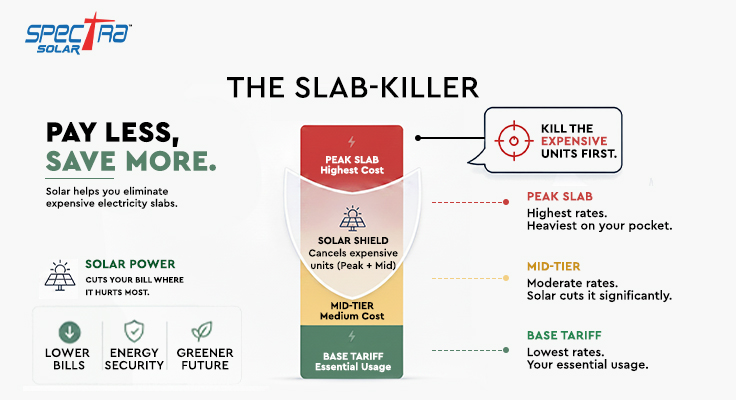
The Insider Strategy: Never over-size your system purely for "profit." The highest ROI comes from offsetting your own high-tariff consumption. This is why the best solar panel company in India will always advise sizing your plant based on your bill’s "slab rate" rather than your total roof square footage. You want to kill the expensive units, not produce cheap ones for the grid.
3. PM Surya Ghar Compliance: Avoiding Mismatches and ALMM Audits
The Ministry of New and Renewable Energy (MNRE) has tightened the digital screws this year. If your solar bill savings for homeowners have stalled, it’s likely not a technical fault, but an administrative one.
Correcting Identity Mismatches
As per the latest PIB updates, the National Portal now uses automated cross-verification. If your electricity bill name slightly differs from your official government identity—a common friction point with initials or middle names—the system flags the file for manual review. This single mismatch can delay your net-metering synchronisation for months. In 2026, your paperwork must be flawless before a single panel touches your roof.
The Hardware Serial Audit
It’s no longer enough to just buy "DCR Panels." The National Portal now tracks the serial number of every module against the manufacturer’s logs. If your installer cuts corners with non-ALMM (Approved List of Models and Manufacturers) gear, the DISCOM will refuse to issue the "Commissioning Certificate." You'll have a functional plant that the grid refuses to acknowledge, leaving you stuck on the old, expensive tariff.
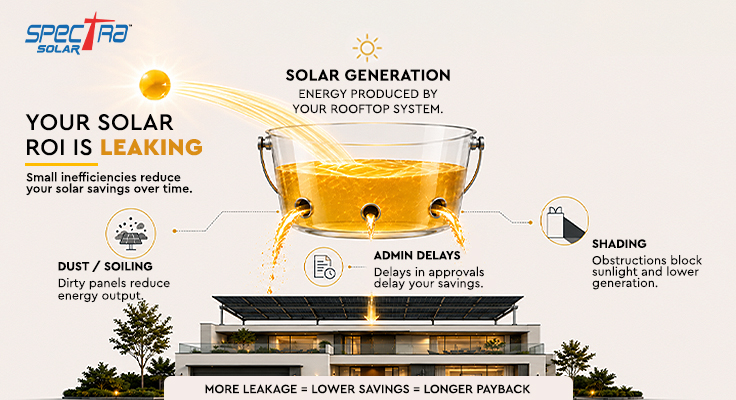
4. Solar Panel Maintenance Strategies to Prevent Credit Loss
In the high-pollution corridors of North India or the coastal salt-belts of the South, "Set and Forget" is a myth that kills ROI. Dust, smog, and bird droppings aren't just aesthetic issues; they are "partial shading" events that trigger bypass diodes and slash generation.
Implementing smart solar maintenance strategies is the difference between a 3-year and a 5-year payback. In 2026, if your app shows a 10% dip compared to the previous week, you are losing money in real-time. We recommend a professional, de-ionised water cleaning cycle every 15 days in urban clusters like Noida or Gurgaon to ensure your "Export" units stay high enough to build a healthy credit bank for the summer.
5. 2026 Solar ROI Analysis: System Costs and Payback Periods
Despite rising component costs globally, the solar system for home price in India has stayed remarkably stable due to massive domestic scaling. When you factor in the state-wise solar subsidy top-ups—which vary wildly from Uttar Pradesh to Gujarat—the net cost of energy has never been lower.
| System Size | Gross Cost (Approx.) | Central Subsidy | State Top-up (Avg) | Net Investment | Payback (Months) |
|---|---|---|---|---|---|
| 2 kW | ₹1,35,000 | ₹60,000 | ₹15,000 | ₹60,000 | 28 - 32 |
| 3 kW | ₹1,85,000 | ₹78,000 | ₹30,000 | ₹77,000 | 30 - 34 |
| 5 kW | ₹3,05,000 | ₹78,000 (Cap) | ₹30,000 | ₹1,97,000 | 48 - 52 |
Note: Figures are 2026 market benchmarks.
With residential tariffs in many Indian cities now crossing ₹10/unit for the highest slabs, solar isn't just about "saving money." It is about capping your "Energy Inflation." By investing today, you are essentially pre-purchasing 25 years of power at a fixed rate of roughly ₹2.50 per unit.
6. Hybrid Solar Solutions: Using Lithium Storage to Offset Peak Tariffs
A standard net-metered system has one major flaw: when the grid goes down, your solar goes down (anti-islanding safety). In 2026, as families demand 100% uptime, we are seeing a pivot toward off-grid solar systems and hybrid setups.
Exploring advanced lithium-ion storage is the definitive move for 2026. This allows you to "time-shift" your generation. Instead of selling your noon surplus to the grid for ₹4, you store it in your own battery and consume it at 8 PM, effectively "selling" it to yourself for ₹10. This internal arbitrage is the next frontier of solar ROI.
7. The Future of Residential Solar: P2P Trading and Microgrids
As we look toward 2030, the conversation is shifting from individual roofs to "Microgrids." We are already seeing regulatory trials for Peer-to-Peer (P2P) trading, where you could theoretically sell your surplus units to your neighbour at a rate higher than the DISCOM’s buyback price. While this is still in its infancy, the foundational step for every homeowner is to secure their own generation capacity now, while solar energy's future in India is being heavily subsidised by the state.
8. Identifying Hidden DISCOM Fees in Your Solar Bill
A common frustration we hear from our clients is: "I generated more than I used, so why is my bill still ₹500?"
It’s critical to remember that while solar eliminates your "Energy Charges," it doesn't touch your "Fixed Charges." Every DISCOM has a fixed meter rent and a sanctioned load fee. Furthermore, some states have introduced "Green Cess" or "Electricity Duty" that applies to the gross consumption before the net-off. Part of our strategy at Spectra Solar Power is to help you audit these bills to ensure the DISCOM isn't overcharging you on the "Net" calculation. Knowing how solar panels reduce electricity bills means understanding every line item on that piece of paper.
Conclusion: Engineering Your Energy Independence
At Spectra Solar Power, we have always maintained that solar is an engineering project, not a retail purchase. The "Muft Bijli" dream is achievable, but it requires more than just high-wattage panels. It requires a meticulous audit of your current consumption, an aggressive stance on paperwork accuracy, and a long-term commitment to system health.
We don't just bridge the gap between your roof and the National Portal; we ensure that your transition to energy independence is mathematically sound and administratively seamless. If you are tired of a meter that only moves in one direction, it is time to look at solar not as an expense, but as the most reliable asset on your balance sheet.

Share This Article


Ready to switch to solar?
Get a free site assessment and no-obligation proposal within 48 hours. Our team covers 100+ cities across India.
-
 Plot No. 2, Landmark Tower, 2nd Floor, South City-1, Ashok Marg, Gurugram, 122001, Haryana
 -

-

RELATED BLOGS