How Educational Institutes in UP Qualify for Zero-Investment Solar — and Why Most Haven't Applied

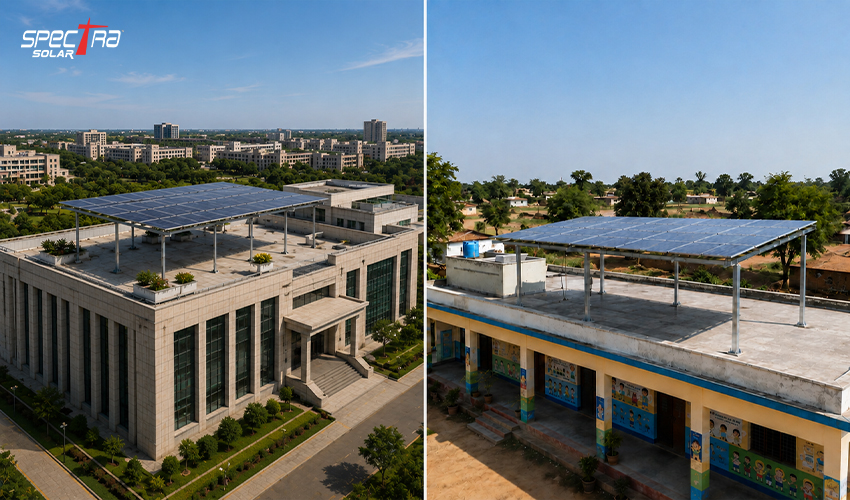
Most schools and colleges in UP are sitting on a rooftop that could be paying their electricity bill instead of adding to it. They just don't know it yet. Solar for educational institutions through the RESCO model means no capital spend, a developer who owns and maintains the whole plant, and a power bill that ends up lower than what the DISCOM charges. The gap here isn't eligibility, honestly. It's that almost nobody's actually looked into it.
What Qualifies UP Educational Institutes for Zero-Investment Solar?
Educational institutes in UP qualify for zero-investment solar through the RESCO solar model, where a third-party developer funds, installs, owns and maintains the rooftop system, and the institute just buys the electricity it generates at a fixed rate below grid tariffs.
Key Takeaways
-
No capital cost, the developer covers design, installation, and upkeep.
-
You only pay for what gets used, and it's usually well under DISCOM rates.
-
Schools run on daytime hours, classes, labs, hostels, which lines up nicely with when solar actually generates.
-
UP has been named specifically as a state pushing third-party ownership models to open solar up beyond institutions that already have spare budgets.
-
Most eligible schools simply haven't applied. Awareness outside the big cities is still pretty low.
Here's what actually qualifies, how the math works, and why so few institutions have taken the step so far.
What Is the RESCO Solar Model?
The RESCO solar model is a zero-investment setup where a Renewable Energy Service Company installs, owns and runs a solar plant on your roof, and you just pay for the electricity it makes through a Power Purchase Agreement. The developer takes on the cost, the maintenance, and the operational risk. Not you.
It's a different animal from buying a system outright. Under RESCO, the developer bears all the costs of installation and upkeep in exchange for access to your rooftop, and you pay a tariff that's noticeably cheaper than grid power. These agreements usually run 15 to 25 years, so it's less a purchase and more a long relationship. The MNRE Rooftop Solar Programme Phase II actually has provisions built in specifically to encourage this kind of arrangement for institutions that can't front the capital.
Why Schools and Colleges Are a Good Fit
Here's the thing, schools burn most of their electricity during exactly the hours solar panels generate the most. Classrooms, labs, hostels, admin blocks, all of it draws load through daylight hours. That means less wasted generation and, usually, no need for expensive battery backup just to make the math work.
Delhi's rooftop programme is a decent reference point here. Delhi government schools on the RESCO model buy power at around ₹3.13 a unit, roughly 65% cheaper than DISCOM rates, and whatever's left over on holidays gets sold back to the grid. UP institutions running a similar setup wouldn't see identical numbers, tariffs differ by state, but the direction of the savings would look about the same.
Why UP Specifically
Commercial solar in UP has picked up momentum lately, and industry trackers now list Uttar Pradesh specifically among the states encouraging third-party ownership models, alongside places like Delhi, Maharashtra and Gujarat. That matters a lot more for schools than for big factories, honestly, since most educational institutes, especially the government-run or budget-tight ones, just don't have a spare line item for a rooftop plant, even when the long-term savings are obvious on paper.
Solar panels in UP adoption have followed the same logic more broadly. DISCOM rates keep climbing, RESCO removes the need for upfront capital, and whoever moves first ends up locking in a tariff that stays flat while everyone still on the grid keeps eating the rate hikes.
RESCO vs Buying Outright
|
Factor |
RESCO (Zero Investment) |
Buying Outright (CAPEX) |
|
Upfront cost |
None, developer funds it |
Full cost paid upfront |
|
Ownership |
Developer owns the plant |
Institute owns it |
|
Maintenance |
Developer's job |
Institute's job |
|
Electricity cost |
Fixed PPA rate, below DISCOM |
Free after payback, self-managed |
|
Risk |
With the developer |
With the institute |
|
Best for |
Budget-tight institutions |
Institutions with capital wanting max long-term ROI |
Worth noting, institutions that do have access to capital or institutional loans often still lean CAPEX, since full ownership plus available government subsidies can mean a payback window as short as 3.5 to 5 years, followed by 20-plus years of essentially free power. RESCO trades away some of that long-run upside in exchange for not needing the capital in the first place, which is exactly the trade most budget-constrained schools are willing to make.

Why Most Eligible Institutes Haven't Applied
The real barrier isn't eligibility. It's that most people running schools and colleges have never had anyone actually walk them through what a RESCO deal looks like. A lot of administrators hear "solar" and assume it automatically means raising capital first, and the conversation just stops there before anyone mentions the developer-owned model exists specifically to remove that step.
There's a trust issue too. Signing a 15 to 25 year PPA is a serious commitment, and without someone explaining the tariff structure, the maintenance terms, or what happens if the institution wants out early, plenty of administrators reasonably hold back rather than sign a contract they don't fully get. That's usually fixed by just working with an established solar EPC company in India, one that'll actually sit down and explain things instead of handing over paperwork and waiting for a signature.
What Qualifies an Institution for RESCO Solar
Most schools, colleges and universities with usable roof space and a decent daytime consumption pattern qualify, regardless of whether they're government or privately run. What actually matters more than the type of institution: roof area with reasonable sun exposure and not much shading through the day, a consistent daytime load, ideally over half of total usage happening while the sun's out, an existing DISCOM connection the solar can offset against, and a willingness to sign a long-term PPA, since that's really what makes the numbers work for the developer on their end.
Institutions running mostly evening or night schedules, some shift-based or vocational colleges, for example, are a weaker fit unless you're pairing it with battery storage, since there's less daytime load around to actually use the generation.
Solar for Schools in UP: What the Process Actually Looks Like
Getting a RESCO project going for a school or college in UP usually runs through five stages: site assessment, tariff proposal, PPA signing, installation, then commissioning with net metering.
-
Site assessment — a developer checks the rooftop, structural load, shading, and pulls daytime consumption numbers from old electricity bills.
-
Tariff proposal — based on that assessment, they propose a per-unit rate, almost always under the current DISCOM tariff.
-
PPA signing — both sides sign, usually 15 to 25 years, covering tariff, escalation clauses, maintenance terms.
-
Installation — the developer funds and installs using ALMM-compliant solar panels for commercial buildings, at no cost to the institution.
-
Commissioning and net metering — DISCOM commissions the connection, and the institute starts drawing solar power at the agreed rate from day one.

Beyond Schools: Where Else This Applies
The same zero-investment logic works for residential and commercial rooftops too, RESCO isn't just for institutions. A solar panel for residential property or a standalone commercial building can run a scaled-down version of the same deal, though residential RESCO is rarer since household consumption doesn't usually justify a 15-25 year developer commitment the way an institution's load does.
Why Work With an Established EPC Partner
A RESCO agreement is only as good as the developer standing behind it for the next couple of decades, so who you pick matters more here than in a regular CAPEX install. Spectra Solar Power works across commercial & industrial and institutional rooftop projects in Uttar Pradesh, handling the site assessment, ALMM-compliant installation, DISCOM coordination and long-term maintenance under the RESCO framework, so institutions aren't signing a twenty-year agreement with someone unproven.
Don't Let "We Don't Have the Budget" Be the Reason You Never Looked Into It
If your institution ruled out solar because there's no capital budget for it, that's the exact assumption RESCO exists to get rid of. The roof's already there. The daytime consumption already lines up. The only thing actually missing is someone sitting down and running the numbers with you.
Get in touch with Spectra Solar Power for a free rooftop assessment and see what a zero-investment plan would actually look like for your campus.
Frequently Asked Questions
1. Does our institution need to pay anything upfront?
No. The developer covers installation, ownership and maintenance. You only pay for the electricity you use, at whatever rate's fixed in the PPA.
2. How long does a RESCO agreement usually last?
Usually 15 to 25 years, covering tariff, maintenance and any escalation clauses agreed at signing.
3. What if we want out of the agreement early?
Exit terms differ by developer and get spelled out in the PPA, which is exactly why it's worth reviewing with someone experienced before signing rather than after.
4. Can private schools apply, or is this only for government institutions?
Private schools, colleges and universities qualify the same way government institutions do, as long as the roof space and daytime usage pattern work.
5. Is our roof probably too small for this?
Not necessarily, honestly the only way to know is a site assessment. Most rooftops with decent sun exposure and manageable shading end up being viable.
6. How's this different from just buying panels outright?
Buying outright means paying the full cost upfront and owning the system, with free power after payback, often in 3.5 to 5 years for a school-scale system with subsidy support. RESCO means no upfront cost at all, the developer owns and maintains everything, and you just pay a fixed, lower rate for what you use.

Share This Article


Ready to switch to solar?
Get a free site assessment and no-obligation proposal within 48 hours. Our team covers 100+ cities across India.
-
 Plot No. 2, Landmark Tower, 2nd Floor, South City-1, Ashok Marg, Gurugram, 122001, Haryana
 -

-

RELATED BLOGS