UP Solar Subsidy 2026: Complete Guide to Prices, Eligibility, Schemes & Application Process

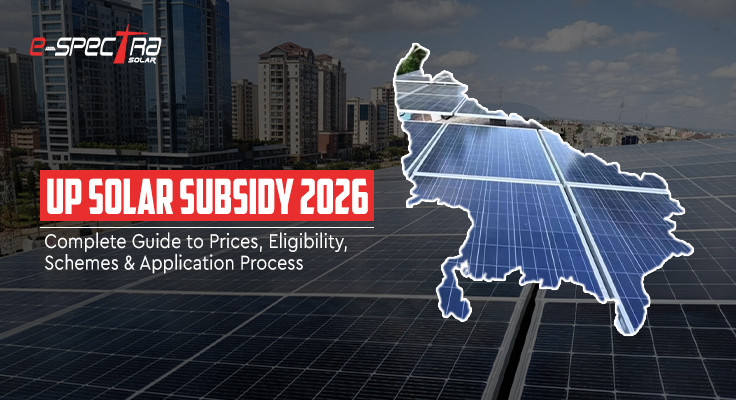
Power bills aren't getting any cheaper in Uttar Pradesh. People want to know where their electricity comes from now, not just what it costs. Solar used to be for the environmentally obsessed. Not anymore. Places like Lucknow, Kanpur, Prayagraj, Varanasi, Gorakhpur, Bulandshahr, Ghaziabad—they all sit under good sun for most of the year.
Yet, the initial capital investment often gives pause. This is precisely where the Central and State Governments have stepped in, uniting their formidable solar initiatives to create a financial pathway that transforms the switch from an ambitious, long-term goal into an immediate, financially sound decision.
This document goes beyond merely listing figures. It provides a humanised, detailed navigation through the intricacies of the prevailing government solar panel scheme UP, focusing particularly on the Central Financial Assistance (CFA) under the PM-Surya Ghar: Muft Bijli Yojana, and the vital supplementary solar subsidy in Uttar Pradesh.
We will methodically clarify eligibility requirements, analyse the true net costs after subsidy, and detail the exact process of how to apply solar subsidy UP for homeowners targeting a smooth installation well into 2026.
The Two-Tiered Financial Advantage: Central and State Support Explained
Adopting solar technology in Uttar Pradesh is remarkably affordable because the financial incentives operate on two powerful, interconnected levels: the national CFA, administered transparently through the central scheme, and the additional, supportive state subsidy offered by UPNEDA (Uttar Pradesh New and Renewable Energy Development Agency).
1. The Core Incentive: Central Financial Assistance (CFA)
The PM-Surya Ghar: Muft Bijli Yojana is undoubtedly the most significant national scheme to date, ambitiously aiming to energise one crore homes across the country with rooftop solar systems. The key feature for residential consumers is the direct transfer of the Central Financial Assistance straight into the beneficiary's bank account, which is a massive step forward for both efficiency and accountability.
The financial structure is explicitly engineered to place the most substantial incentives on smaller, residential systems, which align perfectly with the needs of the average family:
- For the most common household requirement, systems up to 2-kW, the government is offering a generous ₹30,000 per kilowatt. This means a homeowner choosing a 2-kW solar installation can expect a minimum Central Subsidy of ₹60,000.
- Should a property require slightly more power—perhaps a 3-kW solar system, which efficiently meets the needs of a home using around 150 to 300 units monthly—the incentive structure continues its support. The capacity that exceeds the first two kilowatts is subsidised at a rate of ₹18,000 per kilowatt.
- This calculation is capped, ensuring that the maximum Central Subsidy available for any system size from 3-kW and above, for an individual household, is a fixed sum of ₹78,000. So, for instance, a 5-kW system receives the same ₹78,000 CFA as a 3-kW system, strongly nudging consumers towards the most efficient system capacity for their consumption.
2. UPNEDA’s Contribution: The State solar subsidy in Uttar Pradesh
In a concerted effort to significantly accelerate the adoption of the UP rooftop solar scheme, the State Government provides an incentive that works in conjunction with the CFA. UPNEDA has been reliably offering an additional State Subsidy to provide extra financial relief on the project’s initial cost. This support typically amounts to a maximum of ₹15,000 per kW, capped at a ceiling of ₹30,000 per consumer.
The combination of these subsidies creates an undeniable financial benefit. Put in a 2-kW system, and you're looking at ₹90,000 in subsidies total (₹60,000 from Central, ₹30,000 from State). Go with the more popular 3-kW setup, and that jumps to ₹1,08,000. That kind of money knocked off the price means you're earning back your investment way faster. Hard to argue with the numbers.
Breaking Down the Investment: Net Cost of the UP 2-kW/3-kW solar subsidy

When contemplating installation, homeowners naturally focus on the final investment figure. While the actual price varies based on component choice—whether you opt for advanced Mono PERC or TOPCON panels—and the chosen solar company in India, it is possible to project the costs before and after the combined government support.
To put this into perspective, for those eyeing a typical mid-sized system, consider the price estimation prevalent in markets like solar panel prices in Lucknow. A decent 2-kW system runs ₹1,60,000 to ₹1,85,000 before you apply for subsidies. With that ₹90,000 knocked off through the UP 2-kW solar subsidy, you're paying ₹70,000 to ₹95,000 out of pocket. For smaller families watching their budgets, that's actually manageable. You're getting energy independence without needing a massive upfront investment.
A 3-kW system costs around ₹2,10,000 before subsidies. Subtract the ₹1,08,000 you get from the government, and you're looking at ₹1,02,000 to ₹1,30,000 actually coming out of your wallet. Go with quality components, and that money still comes back to you in four or five years just from what you save on electricity. Then you've got another 20 years where the power is basically free.
The Checklist: Eligibility and Technical Non-Negotiables
Securing the full solar panel subsidy in UP necessitates absolute adherence to the criteria established by both the MNRE and UPNEDA. It’s essential to get these details right from the start to avoid processing delays.
First off, this subsidy only works for homes, not businesses. You'll need Indian citizenship and an active electricity connection. The roof has to handle the weight, and you need clear sunlight hitting it—no trees or tall buildings casting shadows. The system has to connect to the grid through net metering, which your local DISCOM will need to approve. It is also vital to confirm that you have not previously claimed any central or state solar subsidy for the same system.
When it comes to technical compliance, two aspects stand out. The first is that the capacity of your proposed rooftop solar plant must not exceed the sanctioned connected load stated on your monthly electricity bill.
The second, and perhaps most critical for long-term reliability and subsidy release, is component compliance: the solar panels used must adhere to the Domestic Content Requirement (DCR) and be sourced from the Approved List of Models and Manufacturers (ALMM).
To simplify this complex requirement, working only with an empanelled solar company—whether you are based with a solar panel in Kanpur or need a specialist in a Solar company in Prayagraj—is the best guarantee of compliance.
The Digital Blueprint: Navigating How to Apply Solar Subsidy UP
The application process has been transformed into a fully digital experience via the national PM-Surya Ghar portal, which streamlines the entire procedure from submission to final payment.
Head to the official portal and set up your account. You'll pick Uttar Pradesh as your state, select which electricity company serves you (your DISCOM), and enter your consumer number along with your phone and email. After that, log back in to fill out the actual application for rooftop solar. This is where you specify what size system you want—say you're going for the UP 2-kW/3-kW solar subsidy.
This application then moves to the DISCOM for Technical Feasibility Approval (TFA). Once the DISCOM confirms that your site and the local grid infrastructure are capable of handling the proposed system, the approval is swiftly granted.
It is at this stage that the consumer takes the pivotal step: selecting an empanelled solar company from the list approved by the DISCOM. This vendor will manage the entire on-site execution, from the physical installation to applying for the Net Meter, which is the heart of the system’s economic viability.
After the vendor completes the installation, the DISCOM conducts a mandatory joint inspection. This ensures the system meets all prescribed technical standards before the all-important Commissioning Certificate is issued.
The final administrative step for the homeowner is to upload this certificate, along with their bank details and a cancelled cheque, onto the national portal. Subsequently, the Central Subsidy (CFA) is transferred directly, followed by the State solar subsidy in Uttar Pradesh from UPNEDA.
Preserving Your Asset: The Necessity of Solar Panel Maintenance Services
The subsidy cuts your upfront costs, but what really matters is whether your system keeps working properly for the next 20 years. That's where solar panel maintenance services come in. This isn't optional if you want your investment protected. Regular checks catch problems early—maybe one string of panels isn't producing what it should, or the inverter's acting up.
Then there's the basic stuff that actually makes a big difference: dirt and dust. Cities have pollution, and panels get filthy. A layer of grime can seriously cut your power output. Whether you're working with a Solar company in Ghaziabad or a Solar company in Gorakhpur, professional cleaning matters.
The same goes for checking your wiring, earthing, and the mounting structure. Things loosen over time. Catch them before they become real problems, and your system will hit that 25-year mark still generating decent power.
Choosing the Right Partner in Uttar Pradesh's Solar Future

The decision to install rooftop solar represents a commitment to energy independence that lasts for a generation. It demands a partnership with a meticulous and highly experienced top solar company in India—one that possesses a deep working knowledge of the local regulatory environment, from the complex DISCOM procedures in Kanpur to the specific structural considerations in smaller towns like solar company in Bulandshahr.
A reliable partner like Spectra Solar Power distinguishes itself by committing to engineered excellence and seamless customer support. They not only provide transparent details on the solar panel price in Lucknow but also guarantee the use of strictly ALMM-compliant components.
Crucially, they are equipped to actively manage the entire, intricate subsidy application process, ensuring your full compliance with the government solar panel scheme UP and the swift, timely disbursement of the solar subsidy in Uttar Pradesh.
By choosing such an empanelled expert, you are securing more than just a system; you are entering a secure, long-term relationship that ensures your energy solution is efficient, fully compliant, and optimally profitable.
With over ₹1,00,000 in combined central and state assistance available for a 3-kW solar system, the current period represents a unique and fleeting financial opportunity. The time to transition is now. Embrace the sun’s potential and let your roof begin generating free, sustainable power for your home.
Divanshi Gupta


Share This Article


Ready to switch to solar?
Get a free site assessment and no-obligation proposal within 48 hours. Our team covers 100+ cities across India.
-
 Plot No. 2, Landmark Tower, 2nd Floor, South City-1, Ashok Marg, Gurugram, 122001, Haryana
 -

-

RELATED BLOGS