Complete Solar Panel Installation Guide for Homes in India (2026)

The global transition to sustainable energy has moved beyond a mere trend; it is now a defining pillar of modern, intelligent home management. As we navigate the economic and environmental landscape of 2026, the convergence of high-efficiency photovoltaic technology, streamlined government support via the PM Surya Ghar: Muft Bijli Yojana, and a heightened awareness of energy independence has positioned residential rooftop solar as an essential asset for the Indian homeowner. This comprehensive guide serves as your strategic roadmap to navigating the technical, financial, and operational facets of solar integration.
1. The Strategic Assessment: Evaluating Your Home’s Feasibility
Before commencing any physical work, a rigorous technical audit is the foundation of a successful project. Solar energy generation is not solely dependent on the quality of the panels; it is a complex interaction of environmental and structural variables that must be aligned for peak performance.
Sunlight Exposure and Orientation
In the Indian geographical context, a south-facing roof orientation remains the gold standard for capturing maximum annual solar irradiance. A detailed site assessment is mandatory to ensure your roof remains free from shade—whether from adjacent structures, overhead trees, or elevated water tanks—ideally during the critical window between 9 AM and 5 PM. Even minor, persistent shading can lead to significant output drops in string-inverter systems, as the performance of a series-connected system is governed by its least productive panel.
Structural Integrity and Mounting
Your rooftop’s load-bearing capacity is paramount. Whether the surface consists of reinforced concrete (RCC) terraces or industrial-grade metallic sheets, the mounting framework must be custom-engineered to withstand local wind speeds and the static load of the hardware.

Load and Capacity Analysis
The capacity of your system, typically ranging from 3kW to 10kW for residential setups, must be aligned with your existing sanctioned electrical load from your local DISCOM. By reviewing your previous year’s consumption, we can determine the precise system size required to maximise your return while remaining within regulatory limits.
2. Navigating the Financial Landscape and Government Subsidies
Strategic financial planning is now significantly more accessible thanks to the PM Surya Ghar: Muft Bijli Yojana. This national initiative has digitised the entire lifecycle of the subsidy process, ensuring transparency and eliminating the delays historically associated with state-level incentives. Central Financial Assistance (CFA)
The current policy framework offers a direct subsidy of ₹30,000 per kW for the first two kilowatts, followed by an additional ₹18,000 for the third kilowatt. This provides a total central benefit of ₹78,000 for installations of 3kW solar panel and above.
The Registration Lifecycle
The process is now entirely portal-based. It is mandatory to partner with a certified, MNRE-empanelled vendor to ensure the installation meets all compliance benchmarks required for subsidy eligibility. Once the system is commissioned and the net meter is successfully installed, the subsidy amount is credited directly to the homeowner’s account through the Direct Benefit Transfer (DBT) system.

3. Sustaining Performance: The Role of Professional Oversight
A solar installation is a long-term capital investment. While panels are durable, the system requires professional oversight to maintain its optimal generation capacity over its 25-year lifespan. Spectra Solar Power stands at the forefront of this sector, offering more than mere hardware deployment; they provide a comprehensive lifecycle management service.
Some companies might promise 'free maintenance,' but we believe in scheduled checkups. If you’re unsure how often your system actually needs attention, check out our guide on choosing between annual and monthly maintenance plans to see what fits your location and system size. Spectra Solar provides specialised Annual Maintenance Contracts (AMC) that go beyond surface cleaning to include deep-level inverter diagnostics, wiring integrity assessments, and thermal inspections.
Why Invest in a Specialised Solar Health Checkup?
-
Getting Your Output Back: Think of dust, bird droppings, or even a layer of city soot as a curtain drawn over your panels. It’s not just a little dirt; it can block enough light to drop your power production by 20% or more. If you don’t clear that off regularly, you’re essentially paying for a system that’s running at partial capacity.
-
Fixing Problems Before They Start: We don't just wait for something to break. Our team uses diagnostic tools to scan for minor voltage drops or inverter quirks. By catching these early, we can often fix a loose connection or a wiring issue in minutes, preventing a complete system shutdown that would cost much more to repair later.
-
Fighting Corrosion: Let’s be honest about the climate, between the humidity and the heat, rust is a real threat to any rooftop gear. We inspect your mounting structures, nuts, bolts, and earthing strips to stop oxidation before it eats away at the frame. It’s the small, preventive steps that keep the system solid for years.
4. The Technical Execution Path: From Concept to Commissioning
The journey to energy independence is divided into four critical phases, each requiring precision and adherence to established engineering standards:
-
System Design: Engineers craft a bespoke layout, prioritising high-efficiency monocrystalline panels. These are currently the most sought-after choice for residential homes, offering superior performance within the space constraints of urban rooftops.
-
Permits and Regulatory Approvals: We handle the necessary liaison with your local DISCOM. This includes the submission of the system design and the procurement of the Technical Feasibility Report (TFR), ensuring that your local grid infrastructure is prepared to integrate your solar export.
-
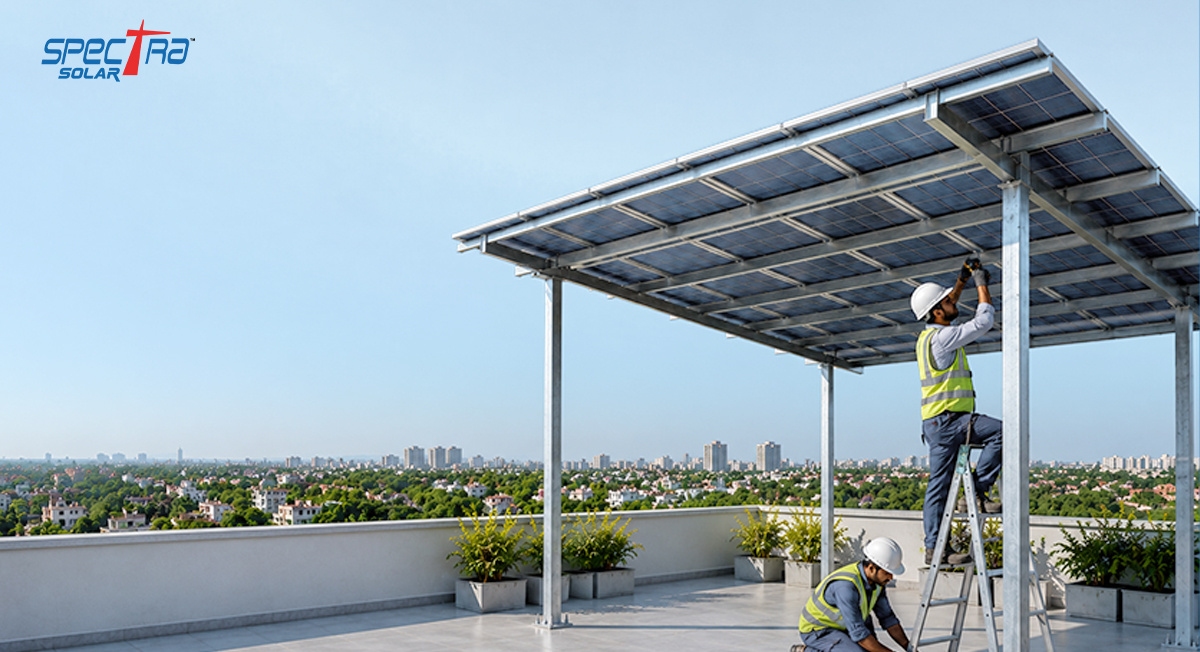
Physical Installation: The hardware phase is where quality is defined. We utilise high-grade, hot-dip galvanised Module Mounting Structures (MMS) and install inverters that act as the intelligent brain of your system, converting captured DC power into usable AC electricity for your household.
-
Net Metering Integration: The process concludes with the commissioning of a bi-directional 'Net Meter.' This device records the electricity you send to the grid versus what you draw from it. Our guide on Net vs. Gross Metering explains why net metering is usually the smarter, more cost-effective choice for residential homes.
5. ROI and the Future of Your Home
The economic argument for going solar is simple: you’re cutting out the most expensive slabs of your electricity bill. With current grid tariffs, most of our clients find that the system pays for itself in 3 to 4 years. If you’re curious about how those numbers look for your specific setup, we’ve broken down the math on ROI and cost recovery here.
But look past the immediate savings. Think of this as "future-proofing" your home. Grid electricity prices have a habit of climbing every year, but your solar generation costs stay fixed from day one. You aren’t just making a purchase; you’re buying yourself insurance against those future hikes.
This isn't just about saving a few units a month. It’s about building a home that runs efficiently on its own terms. By generating your own clean power right on your roof, you’re adding real value to your property and taking the uncertainty out of your monthly overheads. It’s a reliable, low-maintenance way to keep your home comfortable for decades, regardless of what happens to the market price of energy.

Share This Article


Ready to switch to solar?
Get a free site assessment and no-obligation proposal within 48 hours. Our team covers 100+ cities across India.
-
 Plot No. 2, Landmark Tower, 2nd Floor, South City-1, Ashok Marg, Gurugram, 122001, Haryana
 -

-

RELATED BLOGS