PM Surya Ghar Yojana Deadline Is March 2027 — Why Applying Now Beats Waiting

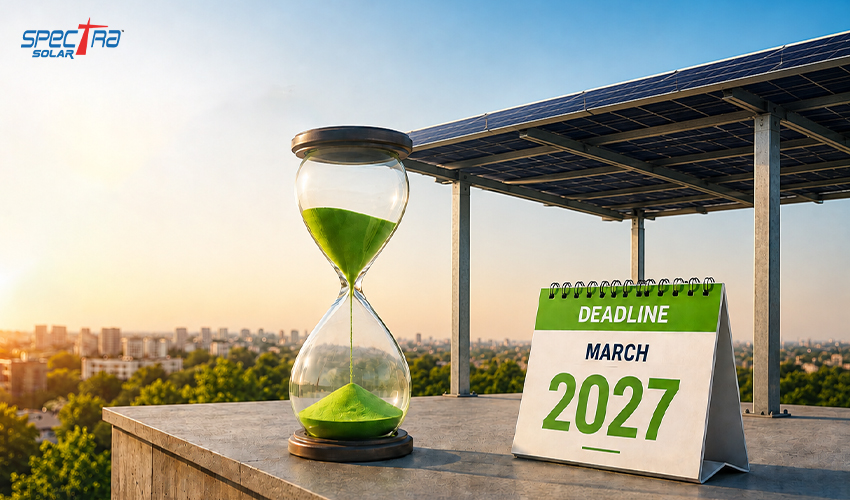
The PM Surya Ghar Muft Bijli Yojana gives homeowners up to ₹78,000 in subsidy and up to 300 free electricity units a month for going solar. The catch: the scheme's built around hitting one crore households by March 2027, and applications keep piling up. Wait too long, and you've got less room to fix anything if your paperwork hits a snag.
PM Surya Ghar at a Glance
PM Surya Ghar Muft Bijli Yojana is a Government of India rooftop solar scheme that gives eligible homeowners, property owners with a residential DISCOM connection, a subsidy of up to ₹78,000 for installing rooftop solar through a registered vendor. The scheme runs on a target of one crore installations by March 2027, and applying earlier means securing today's subsidy terms before that deadline pressure builds.
Key Takeaways
-
The scheme currently offers subsidies up to ₹78,000, based on system size.
-
MNRE data shows over 76 lakh applications received and roughly 39 lakh installations completed as of July 2026, with the pace of applications only increasing.
-
Early applicants get shorter DISCOM queues and lock in today's ALMM equipment rules.
-
No official word exists yet on what happens to the subsidy structure after March 2027.
-
Applying now means more months of free electricity units collected before the target date arrives.
Here's what actually changes as that date gets closer, and why applying now is the safer bet.
What Is the PM Surya Ghar Yojana?
PM Surya Ghar Muft Bijli Yojana is the government's rooftop solar scheme, launched in February 2024 with a target of one crore households by March 2027. It pays ₹30,000 per kW for your first 2 kW and ₹18,000 for the third, capped at ₹78,000, transferred straight to your bank account after installation and commissioning.
The PM Surya Ghar Yojana runs through MNRE and gets implemented by state DISCOMs. Everything happens on one portal, pmsuryaghar.gov.in, there's no separate state websites or offline forms to deal with.
As of July 2026, MNRE data submitted to the Lok Sabha puts the scheme at over 39 lakh completed installations and roughly 14 GW of cumulative rooftop capacity, against 76 lakh applications received so far. That gap between applications and completed installations is worth sitting with for a second, it's the queue you're joining if you wait.
Why Does the March 2027 Deadline Actually Matter?
The deadline matters because the scheme's budget, disbursement pipeline, and DISCOM processing capacity are all planned around reaching one crore households by that date, and applying earlier keeps you ahead of a queue that's only getting longer. Households benefiting from the scheme have crossed 40 lakh within two years of launch, with over 65 lakh applications currently in the pipeline, and DISCOMs are processing more applications every month than they were designed to originally handle.
Nobody's said the subsidy disappears the day after March 2027. But nobody's confirmed it continues on the same terms either. What you do know is that today's subsidy amount, today's equipment rules, and today's processing time are only guaranteed if you're in the pipeline now.
PM Surya Ghar Subsidy Breakdown
|
System Size |
Subsidy Amount |
|
Up to 1 kW |
₹30,000 |
|
Up to 2 kW |
₹60,000 |
|
3 kW and above |
₹78,000 (capped) |
Most urban households land on a 3 kW system since that's where the pm surya ghar subsidy caps out. Payback usually falls somewhere between 2 and 6 years depending on your city's tariffs and how much sun your roof actually gets.

Apply Now vs Apply Near the Deadline
Timing changes more than just how fast your paperwork moves. Here's the practical difference:
|
Factor |
Applying Now |
Applying Near March 2027 |
|
DISCOM queue |
Shorter wait for feasibility approval |
Longer wait as applications peak |
|
Installer availability |
Easier scheduling, more slots open |
Installers booked out, rushed jobs |
|
Equipment rules |
Locked to today's ALMM requirements |
Exposed to further rule changes |
|
Savings collected |
More months of free units banked |
Fewer months before target date hits |
|
Post-deadline terms |
Irrelevant, you're already in |
Whatever comes next is unconfirmed |

Benefits of Applying for PM Surya Ghar Early
Applying early gets you a shorter DISCOM queue, today's equipment rules locked in, and more months of free electricity collected before the target date arrives, three things that only get harder to secure the closer March 2027 gets.
Faster approval. Processing queues are already stretching out as more applications come in, so applying now means a shorter wait for feasibility approval and your actual payout.
Today's equipment rules, locked in. From June 1, 2026, panels need to comply with both ALMM List I and List II, and there's nothing stopping further changes before 2027. Installing under today's rules avoids getting caught out by a rule that didn't exist when you first looked into this.
Earlier savings. Every month you delay is a month of free units you didn't collect. Someone who installs now gets a full extra year of savings compared to someone who waits until early 2027 to even start.
Smoother approval odds. Applications are getting scrutinized harder than they used to be, honestly. Documentation gaps that might've slipped through in 2024 get caught and rejected earlier now. Going through the process while it's well-understood and stable, instead of during a last-minute rush before the deadline, just gives you better odds of it going smoothly.
How to Apply: PM Surya Ghar Yojana Online Apply Process
PM Surya Ghar Yojana online apply happens entirely through the national portal, pmsuryaghar.gov.in: you register with your consumer number, get DISCOM feasibility approval, install through a registered vendor using ALMM-listed panels, and get your subsidy via bank transfer after commissioning.
-
Register on pmsuryaghar.gov.in with your consumer number and DISCOM details.
-
Submit your application with roof details for a feasibility check.
-
Get DISCOM approval confirming your connection and roof qualify.
-
Pick a registered installer and get an ALMM-compliant system installed via solar panel installation.
-
Net metering and commissioning get handled by your DISCOM.
-
Subsidy lands in your account, usually within 30 days of commissioning, once the full 45-90 day process wraps up.
Documents Required
You'll need Aadhaar, a recent electricity bill, proof of property ownership, Aadhaar-linked bank details, and a registered mobile number, that's the full list DISCOMs ask for before approving a PM Surya Ghar scheme application. Keep these ready before you start, it saves a back-and-forth later:
-
Aadhaar card
-
Recent electricity bill (with consumer number)
-
Property ownership proof
-
Bank account details, Aadhaar-linked
-
Registered mobile number for OTP verification
Who's Actually Eligible?
Eligibility comes down to five things: property ownership, a residential DISCOM connection, roughly 10 sq. m of shadow-free roof per kW, an Aadhaar-linked bank account, and not having claimed the subsidy already on that same connection.
You need to own the property, joint ownership is fine. You need a residential DISCOM connection, not commercial. Your roof needs roughly 10 sq. m per kW with no major shade during peak hours. Your bank account needs to be Aadhaar-linked with a matching name for the transfer to go through. Tenants can't apply, only owners. And you can only claim this once per electricity consumer number, it doesn't reset if the property changes hands.
Apartment owners can apply too, though it usually goes through the resident welfare association or society instead of as an individual application, since the roof itself is common property anyway.
What Happens If You Miss the Deadline?
Nobody knows yet, honestly. The scheme's whole design is built around that March 2027 target, and there's been no word on whether things stay the same after, get scaled down, or just wind up entirely. Which is kind of the point, waiting means betting on terms that haven't actually been confirmed by anyone.
Why Work With an Experienced Installer
An experienced installer manages ALMM compliance, DISCOM coordination and subsidy follow-up on your behalf, which is exactly where most rejected applications go wrong when handled alone. With this much paperwork and equipment compliance involved, a government solar panel scheme like this one really rewards going with someone who handles the whole thing, not just someone who drops panels on your roof.
Roughly a third of PM Surya Ghar applications stall or get rejected at the DISCOM inspection or subsidy disbursement stage nationally, and most of that traces back to stuff that's entirely avoidable, wrong panels, missing documents, an installer who isn't even registered.
Spectra Solar Power is recognised as one of the best solar panel companies in India for residential rooftop work, with certified engineering teams handling site surveys, ALMM-compliant solar installation, DISCOM coordination, and subsidy follow-up. As a top solar company in India in this space, the focus stays on getting homeowners through the full PM Surya Ghar process, not just supplying hardware, so you're not stuck chasing paperwork for months on your own.
Don't Let the Deadline Make the Decision for You
The subsidy itself isn't shrinking based on when you apply within the window. But everything around it, the wait times, the equipment rules, how strict the process is getting, is only moving in one direction. If you've been meaning to go solar, treat March 2027 as the date you want to already be done by, not the date you finally get started.
Get a free rooftop survey done with Spectra Solar Power and find out what you're eligible for before March 2027 rolls around.
Frequently Asked Questions
1. What is the PM Surya Ghar Muft Bijli Yojana?
The government's rooftop solar scheme gives eligible homeowners up to ₹78,000 in subsidy and up to 300 free electricity units a month if you install through a registered vendor.
2. What's the subsidy for a 3kW system?
₹78,000, that's the max. Doesn't matter if your system's bigger, the subsidy still caps out at 3 kW.
3. How long does the whole process take?
Usually somewhere between 45 and 90 days, depends a lot on how backed up your DISCOM's inspection queue happens to be.
4. What documents do I need?
Aadhaar, a recent electricity bill, proof you own the property, bank details linked to Aadhaar, and a mobile number for the OTP.
5. Is the scheme actually ending in March 2027?
Not exactly. That's just the target date for hitting one crore households. Nobody's actually said what happens to the subsidy after that, which is kind of the whole reason to apply now while the terms are still guaranteed.

Share This Article


Ready to switch to solar?
Get a free site assessment and no-obligation proposal within 48 hours. Our team covers 100+ cities across India.
-
 Plot No. 2, Landmark Tower, 2nd Floor, South City-1, Ashok Marg, Gurugram, 122001, Haryana
 -

-