N-Type vs P-Type Solar Panels: Which One Delivers Better Efficiency and Performance?

Discussions on n type vs p-type solar panels hardly take the right direction at the right place. The majority of the buyers leap to the pricing, at times brand names, efficiency figures that are occasionally dragged out of context. What is overlooked is the behaviour of these panels with time. It is at that point that the true separation takes place.
Solar Panels are not a day-time buy. It is a 20 to 25-year commitment. The panel type does it silently by dictating the amount of electricity produced in that whole time. Not just in year one.
What are n-type solar panels?
Phosphorus-doped silicon is used to make N-type solar panels. This adds additional electrons, and these are charge carriers. The design does not engage some chemical changes that result in loss of performance at an early stage.
What are p-type solar panels?
P-type panels are made of boron doped silicon. They do not use electrons, but instead, they use holes to conduct charge. This is an older technique that is more commonly employed because of cost reduction in production.
This is what sets the difference between n type and p type solar panels. The material looks similar. The behaviour in the sunlight does not.
N-Type vs P-Type Solar Panels: Key Differences in Performance
The difference is more evident when the panels are subjected to real conditions.
How N Type Solar Panels Work
Freely moving electrons are found within the cell. The material structure helps the panel to resistant Light-Induced Degradation and thus the panel remains in the same efficiency as before.
How P Type Solar Panels Work
Boron reacts with oxygen in the sunlight. This induces Light-Induced Degradation. The panel exhibits a decrease in efficiency at an early stage followed by a stabilisation. Such a difference might appear insignificant at the beginning. It is not small over time.
N-Type Solar Panels Efficiency vs P-Type Solar Panels Efficiency

| Parameter | N-Type Panels | P-Type Panels | What It Means |
|---|---|---|---|
| Efficiency range | 21% to 23% | 18% to 20% | More power per square metre |
| Initial degradation | Minimal | Present due to LID | Better day-one to year-one retention |
| Low light output | Higher | Moderate | Better generation in haze or winter |
| Long-term yield | Higher | Lower | More units over system life |
Solar Panel Technology Comparison That Goes Beyond Brochures
| Factor | N-Type Panels | P-Type Panels | Practical Impact |
|---|---|---|---|
| Annual degradation | ~0.4% | 0.5% to 0.7% | Slower output loss |
| Temperature coefficient | Better | Weaker | Less loss in Indian summers |
| Material stability | High | Moderate | Fewer long-term defects |
| Lifespan performance | Consistent | Gradual drop | More predictable output |
A proper solar panel technology comparison cannot rely only on efficiency numbers. Heat, degradation, and stability define real performance.
Which Is Better N Type or P Type Solar Panels?
| Decision Criteria | N-Type Panels | P-Type Panels | Verdict |
|---|---|---|---|
| Upfront cost | Higher | Lower | P-type wins short-term |
| Output over 25 years | Higher | Lower | N-type wins long-term |
| ROI | Stronger | Moderate | N-type more efficient |
| Market maturity | Growing | Established | P-type more available |
So, which is better, n-type or p-type solar panels?
The answer depends on what is being optimised. If the decision is driven by initial budget, P-type panels remain relevant. If the focus is long-term energy generation, N-type panels pull ahead. Treating them as equal options leads to poor decisions.
Real-World Use: Residential and Industrial Context
The context of installation changes the decision-making process.
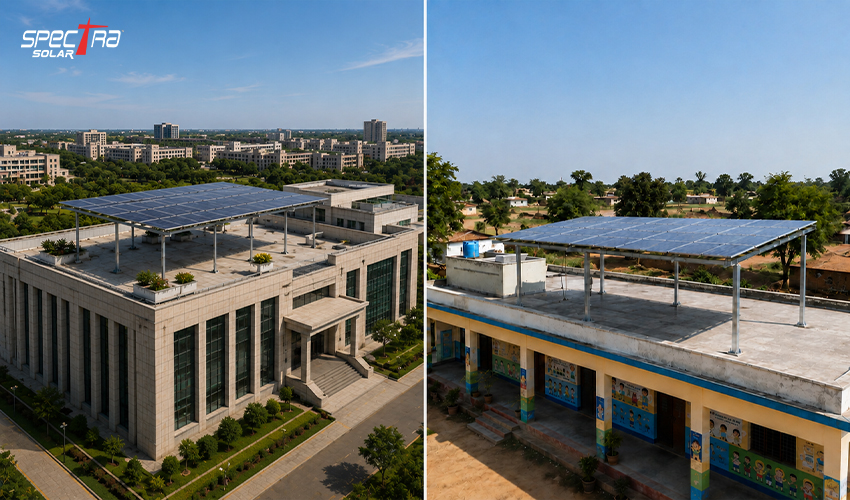
For homes, especially in cities, roof space is limited. That makes solar panels for residential setups sensitive to efficiency. N-type panels extract more power from the same space, which directly improves savings.
For industrial use, the scale is larger, and energy demand is continuous. In solar panels for industry india, consistency matters more than peak efficiency. Output fluctuations translate into operational impact.
For commercial solar rooftop systems, the effect multiplies. A 2 per cent efficiency gain across a large installation leads to significantly higher generation over time.
Quick comparison
| Use Case | What Matters Most | Better Fit |
|---|---|---|
| Residential rooftops | Space efficiency | N-type |
| Industrial setups | Stability and consistency | N-type |
| Budget-limited projects | Lower upfront cost | P-type |
| Large-scale rooftops | Total energy output | N-type |
The pattern is clear. The longer-term the thinking, the stronger the case for N-type.
Pricing, ROI, and Where the Thinking Goes Wrong
The solar system for home price is often treated as the final decision point. That is where most buyers go wrong.
N-type panels cost more upfront. That is visible. What is less visible is how much more electricity they generate over time.
Let’s break it down simply.
- Higher efficiency means fewer panels for the same output
- Lower degradation means consistent performance over years
- Better heat resistance means less loss during peak summer
Now contrast that with a typical decision pattern. Buyers compare quotations. The cheaper option looks attractive. The output difference is not factored in properly.
Reality check analysis
| Factor | Short-Term View | Long-Term Reality |
|---|---|---|
| Cost | Lower is better | Output defines value |
| Efficiency | Ignored after purchase | Drives generation |
| Degradation | Overlooked | Reduces lifetime output |
| ROI | Based on initial savings | Based on total units generated |
The mistake is simple. Cost is treated as fixed. Output is treated as assumed. It should be the other way around.
Maintenance and System Behaviour Over Time
Solar systems do not run untouched. Environmental conditions play a role. With solar panel maintenance services, cleaning and inspection remain necessary. Dust accumulation alone can reduce efficiency by a noticeable margin.
N-type panels tend to handle long-term stress better. Their structure reduces certain degradation pathways, which keeps performance more stable. This does not eliminate maintenance. It reduces performance variability.
Connecting Panel Choice with Broader Solar Decisions
Panel selection interacts with other parts of the system. Understanding what is Net metering helps in calculating how surplus energy is credited. Higher efficiency panels can increase export potential.
A Solar Calculator provides estimates, but often assumes standard panel output. That can understate the benefits of higher efficiency modules. Knowing What is Solar Billing ensures that savings are calculated correctly, not assumed.
Other elements like factors that affect solar prices influence timing and investment decisions. For a broader understanding, topics such as benefits of using solar power and half-cut solar panels provide additional clarity on system performance.
Where Spectra Solar Power Comes In
System design is rarely about just picking a panel. It involves aligning performance expectations with actual usage. Spectra Solar Power approaches installations with that alignment in mind. Panel type is selected based on long-term output requirements, not just initial cost.
Whether the requirement involves residential setups or commercial solar rooftop systems, the focus remains on building systems that deliver consistent energy over time.
Final Take
The debate around n-type vs p-type solar panels often gets reduced to a pricing argument. That misses the larger point. P-type panels are cost-effective and widely used. N-type panels are more efficient, degrade more slowly, and perform better under real-world conditions.
The decision is not about what costs less today. It is about what delivers more over the decades. Most buyers think they are choosing between similar technologies. They are not. The difference only becomes obvious after the system has been running for years.

Share This Article


Ready to switch to solar?
Get a free site assessment and no-obligation proposal within 48 hours. Our team covers 100+ cities across India.
-
 Plot No. 2, Landmark Tower, 2nd Floor, South City-1, Ashok Marg, Gurugram, 122001, Haryana
 -

-

RELATED BLOGS