Solar Panels for Commercial Buildings: Costs, Benefits, ROI & Setup Guide

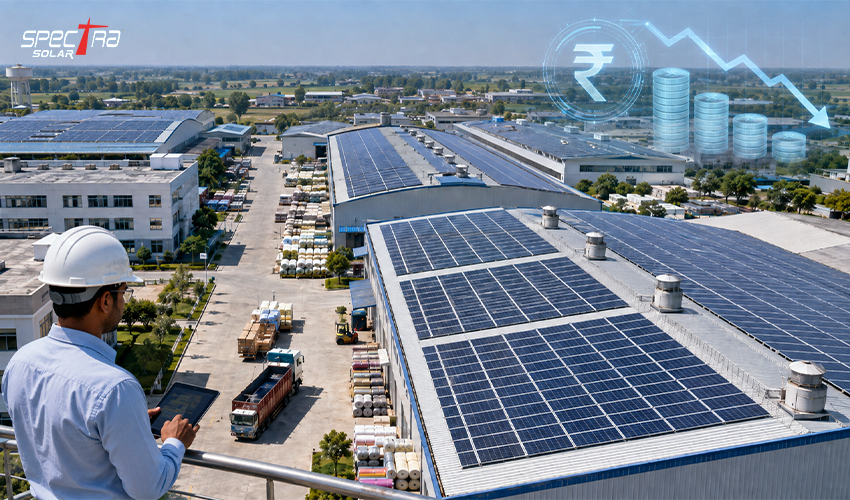
At some point in the history of most commercial building owners, the electricity bill ceases to remain a line item and becomes a real issue. The current Haryana commercial consumer tariffs in DHBVN are between ₹6.45 and 6.95 per unit on low-tension connections, which excludes fixed charges, peak-load excursion charges, or the gradual 5 per cent 7 per cent annual increase that is now an almost certainty.
It is against that backdrop that solar panels of commercial buildings are not an aspirational sustainability option any longer. They are becoming, more and more, a common financial choice.
What Does a Commercial Solar Setup Actually Cost in India?
The cost of a solar setup for commercial use is genuinely scale-dependent, and the economies of scale here are meaningful. A 50 kW system costs proportionally more per kW than a 1 MW installation, because the fixed engineering and regulatory costs are spread across fewer kilowatts. That said, pricing in the market for 2025–26 has stabilised in a range that most commercial entities can model with confidence.
| System Size | Approx. Cost (excl. GST) | Annual Generation (Units) | Daily Generation (Units) | Typical Payback |
|---|---|---|---|---|
| 50 kW | ₹12,50,000 | 70,000 – 80,000 | 200 – 225 | 3 – 4 years |
| 100 kW | ₹24,00,000 | 1,40,000 – 1,60,000 | 400 – 450 | 2.5 – 3.5 years |
| 200 kW | ₹47,00,000 | 2,80,000 – 3,20,000 | 800 – 900 | 3 – 4 years |
| 500 kW | ₹1,17,50,000 | 7,00,000 – 8,00,000 | 2,000 – 2,250 | 3 – 4 years |
| 1 MW | ₹2,35,00,000 | 14,00,000 – 16,00,000 | 4,000 – 4,500 | 3 – 5 years |
Breaking Down the Benefits: Why the Case for Solar Is Getting Harder to Ignore
Here is a breakdown of what a well-designed system actually delivers for a commercial building:
| Benefit | What It Means for Your Business |
|---|---|
| Electricity Bill Reduction | 60%–90% of daytime consumption offset; direct cut in monthly operational costs. |
| Accelerated Depreciation (AD) | Claim 40% depreciation in Year 1 under Section 32 of the Income Tax Act; reduces taxable income immediately. |
| Input Tax Credit (ITC) | GST paid on solar components (~5%) can be offset against your outward GST liability, preserving working capital. |
| Net Metering Credits | Surplus power exported to the grid earns bill credits; unadjusted units at year-end are purchased by DHBVN at 75% of the SECI tariff. |
| Carbon Credits | Large installations begin accruing carbon credits from Year 2 onwards, adding a secondary revenue stream as India's carbon market matures. |
| Energy Price Certainty | Fixed generation cost for 25 years insulates the business from grid tariff escalation, which has been averaging 5%–7% annually. |
| ESG & Compliance Value | A 100 kW system offsets approximately 110 tonnes of CO₂ per year; valuable for ESG reporting and corporate sustainability disclosures. |
Businesses whose load profile is seasonal or with multi-shift operations alter the calculus on the net metering framework in Haryana. To further understand the process of billing under this model, our blog net metering vs gross metering addresses the mechanics in simple language.
Understanding Commercial Solar ROI: The Numbers That Matter
The question of commercial solar ROI is one we get asked constantly, and the honest answer is that it varies by system size, financing model, and local tariff rates. What we can say with confidence is that, for commercial installations in Haryana, the numbers are among the most favourable they have ever been.
The table below models the financials across three common system sizes, using DHBVN commercial tariff rates and verified generation estimates based on Haryana's average solar irradiation of 5.5–6.0 kWh/m²/day.
| Parameter | 100 kW System | 500 kW System | 1 MW System |
|---|---|---|---|
| Capital Investment | ₹24,00,000 | ₹1,17,50,000 | ₹2,35,00,000 |
| Annual Generation | ~1,50,000 units | ~7,50,000 units | ~15,00,000 units |
| Annual Savings (@ ₹7/unit) | ₹10,50,000 | ₹52,50,000 | ₹1,05,00,000 |
| Year 1 Tax Saving (40% AD @ 25%) | ₹2,40,000 | ₹11,75,000 | ₹23,50,000 |
| Simple Payback Period | ~2.3 years (with AD) | ~2.2 years (with AD) | ~2.0 years (with AD) |
| Indicative IRR | 23%–25% | 24%–26% | 25%+ |
| 25-Year Cumulative Savings | ₹3.5 Cr+ | ₹17 Cr+ | ₹35 Cr+ |
Since the choice between ownership and the OPEX route comes up in most conversations we have with commercial clients, the comparison below is worth having on hand.
| Parameter | CAPEX Model | OPEX / RESCO Model |
|---|---|---|
| Ownership | Business owns the asset | Developer owns the plant |
| Upfront Cost | Full investment required | Zero capital outlay |
| Maintenance | Business's responsibility | Developer's responsibility |
| Savings from Day 1 | After payback (~2–4 years) | Immediate (20%–40% below grid rate) |
| Tax Benefits | 40% AD + ITC available | Developer claims depreciation |
| Long-term ROI | Highest (18%–25%+ IRR) | Savings-only; no capital ROI |
| Best Suited For | Businesses with available capital & long-term property interest | Businesses prioritising liquidity or short-term lease tenure |
Installation of a Commercial Solar Power Plant: Step-by-Step
The way of establishing a business solar power plant is more systematized than most business owners anticipate and the reason is that there is a reason behind the structure. The next stage is based upon the previous one and the shortcuts made during early stages are likely to manifest in the form of problems during commissioning or during the first monsoon season. Here is our approach to it:
- Phase 1: Site Feasibility and Shadow Analysis:
This is the starting point. We determine your roof or available ground space to give shadow free coverage (the cut-off is around 10 sq. metres per kWp), the structural load-bearing capacity and the south-facing orientation. Shading by neighboring buildings or rooftop equipment is the solitary largest reason of under performance in systems that were not designed in this manner.
The RTK-GPS surveys by drones are now being used by advanced EPC companies in India to generate a 3D version of panel placement under a sub-centimetre range, and we are using this method on larger commercial projects. Shadow analysis should ensure that there is no shading between 9:00 AM and 3:00 PM especially during the winter solstice when the sun path is lowest. - Phase 2: System Design and Component Selection: The system design is completed once the data is available about the site. In the majority of commercial solar electric systems, the default is an on-grid design, as it does not require battery costs and also allows net metering. A hybrid construction with a small battery can be considered in case of buildings with high loads or unstable grid power.
-
Phase 3: DHBVN / Regulatory Approval: In Gurugram and Haryana, commercial systems pass through the DHBVN Solar Connection portal to have the net metering application. The processes are in the following order:
- Submission of application online along with electricity bills, ownership documents and a 1,000 processing fee.
- DHBVN field offices require approval of technical feasibility that is 3 days of systems up to 10 kWp, 15 days for larger systems.
- Letter of Approval (LOA) by the Executive Engineer.
- Signing of Net Metering Agreement with the Sub-Divisional Officer.
- Installed in 180 days of LOA, by an empanelled vendor.
- Above 20 kWp: safety certificate of the Chief Electrical Inspector.
- Installation and formal commissioning of bi-directional meters.
-
Phase 4: Procurement and Installation:
Physical installation is inclusive of panel mounting, inverter installation, cabling and earthing as well as connection to the main distribution board. The quality of workmanship during this stage is what defines the behaviour of the system in 25 years.
We have experienced systems which were fine when commissioned, but have turned out to have problems after two monsoon seasons due to a fabrication of the mounting structure below specifications or careless cable management. There is no place where cost-cutting can pay off. - Phase 5: Grid Synchronisation and Commissioning: When the DISCOM check is done, and the bi-directional meter is fitted, the system is officially commissioned. This should be the point of generation monitoring. Monitoring using SCADA enables the building managers to monitor the outputs in real-time and detect any underperformance early.
A Word on How Spectra Solar Works
We are Spectra Solar Power, and we are among the commercial solar firms with over five years of activity in this industry, and therefore we know what it is like to install a bad quality five years down the line. Having 1,000+ solar installations in residential, commercial, and industrial segments, we base our strategy on a consultation-first model: we begin with your real consumption data and the physical limitations of your building, not with a pre-made package.
Final Thoughts
The conversation around solar panels for commercial buildings cost in India has shifted materially in the last three years. What was once a long-payback, specialist decision is now, with declining module costs, a more mature EPC ecosystem, and regulatory frameworks that actually support commercial prosumers, one of the better-returning capital investments available to a business.
The HERC 2025 amendments, the removal of the 90% consumption cap, and the accelerated depreciation framework together create a set of conditions that would have seemed unusually favourable not long ago.
Divanshi Gupta


Share This Article


Ready to switch to solar?
Get a free site assessment and no-obligation proposal within 48 hours. Our team covers 100+ cities across India.
-
 Plot No. 2, Landmark Tower, 2nd Floor, South City-1, Ashok Marg, Gurugram, 122001, Haryana
 -

-

RELATED BLOGS