What Are Solar Parks and How Can UP Businesses Buy Power from Them?

For decades, the energy narrative in Uttar Pradesh was simple: pay the monthly DISCOM bill, grumble about the inevitable power fluctuations, and treat electricity as a static, unavoidable tax on production. But the landscape has shifted. With industrial margins tightening and the global demand for ESG (Environmental, Social, and Governance) compliance intensifying, the "standard" approach to power procurement is no longer just a budget line item; it’s a critical business risk that requires immediate mitigation.
Forward-thinking companies have stopped looking at electricity as a commodity and started treating it as a risk-management issue. They aren't just hunting for cheaper units; they are chasing energy resilience, the ability to keep the floor running regardless of what the grid is doing. For an operator, plugging into solar parks in Uttar Pradesh isn't just an environmental initiative; it is a hard-nosed tactical play.
By ditching the fragmented, unreliable mess of traditional power procurement and consolidating their energy footprint into a centralised, utility-scale model, these businesses are buying the one thing money usually can't get: the operational stability to scale without fear of a grid-induced shutdown.
What Are Solar Parks? (The Energy "Industrial Estate")
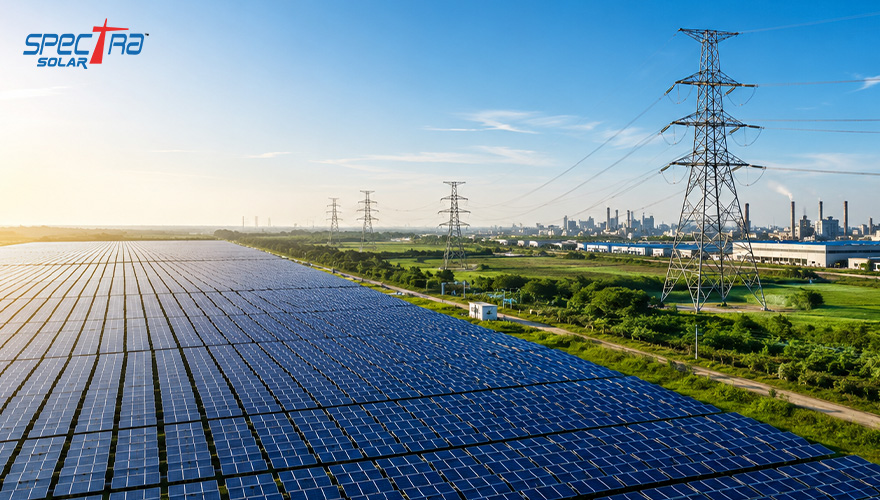
If you were to strip away the technical jargon, what are solar parks? Think of them as "Energy Industrial Estates." Instead of a factory attempting to balance its own limited rooftop capacity or navigating the nightmares of land acquisition and complex grid-syncing, a solar park is a concentrated, developer-managed zone dedicated to clean energy production.
These parks bundle thousands of acres and hundreds of megawatts into a single, high-efficiency hub. By centralising infrastructure, like high-voltage substations, dedicated transmission lines, and automated security, the cost of generation drops, and reliability skyrockets. For a business, this isn't just "going green"; it’s a high-level operational hedge against the inherent volatility of the legacy power grid. These parks serve as the engine room for the future of industrial production, offering a scalability that rooftop units simply cannot touch.
The Reality of the Legacy Grid: The "Invisible" Cost
To understand the urgency of this pivot, we have to look at the traditional grid infrastructure. The state’s industrial backbone, represented by iconic, long-standing facilities like the Rihand and Singrauli thermal stations, has served us well, but it is an ageing engine struggling to keep pace with modern digital demands and 24/7 production cycles.

The primary issue isn't just fuel availability; it’s the distribution bottleneck. Aggregate Technical and Commercial (AT&C) losses act as a silent tax on businesses, where a significant percentage of generated electricity is lost or wasted before it even reaches the end user. Every time your equipment suffers from a voltage flicker, a phase imbalance, or a production line halts due to a grid trip, you aren't just losing time—you're losing your competitive edge.
The Open Access Framework: How Businesses Buy Power from Solar Parks
The most common question we hear is: how do businesses buy power from solar parks? The answer lies in the Green Open Access framework. Under the Ministry of Power’s regulations, commercial and industrial (C&I) consumers with a contracted demand of 100 kW or more can bypass the traditional DISCOM structure to procure power directly from a renewable generator.
Three Primary Procurement Models for Businesses:
-
Third-Party PPA: You sign a long-term contract with a solar developer. You pay a pre-set tariff, and they deliver the power through the state grid. There is zero capital expenditure (CAPEX) on your end, just immediate operational savings that reflect on your monthly balance sheet.
-
Captive Model: You own at least 26% of the solar project equity. This is widely considered the "gold standard" for massive industrial consumers because it waives the Cross-Subsidy Surcharge (CSS) and other state-imposed levies, offering the absolute lowest per-unit cost over a 25-year lifecycle.
-
Group Captive: A consortium of businesses pools their demand to co-own a project. It’s perfect for mid-sized units that want the efficiency and cost-benefits of a captive plant without the administrative burden of 100% project ownership.

Leveraging Policy Incentives in Uttar Pradesh
The Uttar Pradesh Solar Energy Policy 2022 has completely rewritten the rulebook for C&I (Commercial and Industrial) consumers. It’s no longer just about token environmental gestures; it’s about a structural overhaul of how you account for power costs. By plugging into these state-level mandates, businesses are finally unlocking a suite of financial levers that were historically gated or non-existent, turning solar from a "nice-to-have" sustainability project into a hard-hitting tool for competitive advantage.
-
100% Electricity Duty Exemption: Applicable for 10 years for C&I consumers switching to solar.
-
50% Waiver on Wheeling & Transmission Charges: A massive reduction in the cost of "moving" your solar power from the park to your factory gate.
-
Full Energy Banking: You can feed excess energy back into the grid and draw it when your production peaks, effectively using the grid as a giant virtual battery.
-
Stamp Duty Exemptions: Significant relief on land acquisition/lease for solar-dedicated projects.
The Strategic Advantage: Why Now?
Why are we seeing a surge in commercial solar power purchase in Uttar Pradesh? It’s not just environmental benevolence; it’s cold, hard math.
-
The "Fixed-Cost" Hedge: Grid tariffs climb almost every year as utilities pass on their rising fuel and operational costs. A solar PPA locks in your rates for 15–25 years, creating an "inflation-proof" energy budget that protects your long-term profit margins.
-
ESG as a Currency: If you are a Tier 1 supplier or an exporter, you already know the drill: your global buyers aren’t just looking at the quality of your parts anymore; they’re auditing your entire carbon footprint. Sustainability has effectively become a form of currency. When you procure power from a solar energy park, you aren’t just buying electricity; you’re generating the Renewable Energy Certificates (RECs) and the clean, verifiable audit trails necessary to retain high-value contracts that would otherwise be out of reach.
-
Operational Uptime: If you are still entirely at the mercy of the ageing state grid, you are only one bad weather event or substation trip away from a complete production halt. Smart operators have stopped relying on a single point of failure. Instead, they are bridging the gap by pairing open-access solar with on-site energy storage, creating a reliable buffer that keeps the plant humming even when the main grid decides to take an unplanned break.
Solar Parks vs. Rooftop: A Strategic Decision Matrix
Not every business should build a rooftop plant. If you lack the structural integrity for solar panels for commercial buildings or need capacity far beyond your roof’s footprint, the off-site solar energy park is your only viable path to meaningful scale.
|
Factor |
Rooftop Solar |
Solar Park (Open Access) |
|
Scale |
Limited to roof area |
Tens of megawatts |
|
Capital |
High upfront |
Zero/Low (PPA model) |
|
Maintenance |
Your operational burden |
Developer managed |
|
Grid Reliance |
Low (Self-consumption) |
High (Grid-delivery) |
Navigating the Regulatory Landscape
Finding the best solar system company in India is straightforward, but finding a partner who understands the nuance of UP’s specific regulatory environment is the real challenge. The policy framework for commercial solar power systems is constantly evolving, and partnering with experienced solar park developers in India who have navigated the UPERC landscape is essential to avoid legal and technical pitfalls.
Case Study: The Hospitality Pivot
Solar power for hotels in India has hit a tipping point. For hotels, energy is the pulse of the building; from climate control and high-intensity laundry operations to the non-stop 24/7 service demand, they are high-load, constant-draw consumers. By moving away from conventional utility dependence and shifting to an off-site solar model, luxury properties are finally turning their most volatile utility cost into a stable, predictable, and green-certified line item.
It is a strategic move that does more than just protect the bottom line; it actively boosts guest acquisition. Modern, eco-conscious travellers are no longer just looking for luxury; they are scouting for hotels that demonstrate a genuine, verified commitment to renewable energy.
The Future of Industrial Energy in UP
As Uttar Pradesh cements its status as a global manufacturing hub, energy security is quietly becoming the single biggest differentiator between the market leaders and those destined to struggle. In this new industrial era, energy is no longer a passive "cost of doing business" to be filed away in the accounts; it is a core strategic asset.
By decoupling your operations from the inherent volatility of legacy thermal grids, you are doing more than just trimming the monthly budget; you are effectively future-proofing your entire manufacturing floor against a decade of inevitable energy inflation. This isn't just about survival; it is about establishing a base of operations that can scale without being held hostage by the constraints of the traditional power infrastructure.
Conclusion: Driving Excellence through Energy Resilience
The transition to solar isn't just about ticking boxes for environmental compliance. It is about taking total control of your most significant overhead. As UP continues to industrialise, the businesses that thrive will be those that have effectively decoupled their operations from the instability of the legacy grid.
At Spectra Solar Power, we know that a company’s sustainability narrative is only as credible as the infrastructure backing it. Whether you are scaling your production capacity or optimising your operational overhead, the core philosophy remains the same: strategic foresight today is the only way to avoid systemic crises tomorrow. We encourage you to move beyond viewing power as a passive monthly expense and start treating your energy procurement as a non-negotiable pillar of your business growth. When your energy is secure, your production doesn’t stall, your costs stop fluctuating, and your business becomes truly unstoppable.

Share This Article


Ready to switch to solar?
Get a free site assessment and no-obligation proposal within 48 hours. Our team covers 100+ cities across India.
-
 Plot No. 2, Landmark Tower, 2nd Floor, South City-1, Ashok Marg, Gurugram, 122001, Haryana
 -

-

RELATED BLOGS