Faridabad Homeowner Guide: Cutting Household Bills with Rooftop Solar
Surviving a summer heatwave in Faridabad is a direct test of both your patience and your household budget. When the temperature breaks past 45 degrees Celsius across old residential sectors and dense builder floors alike, running high-tonnage air conditioning units becomes an absolute necessity.
However, keeping your home livable comes with a punishing financial downside. Relying entirely on the local public grid means watching your monthly utility bill climb directly into the most expensive DHBVN tariff slabs. During peak seasons, local infrastructure faces massive transformer strain, leaving families to deal with sudden power cuts right when they need cooling the most.
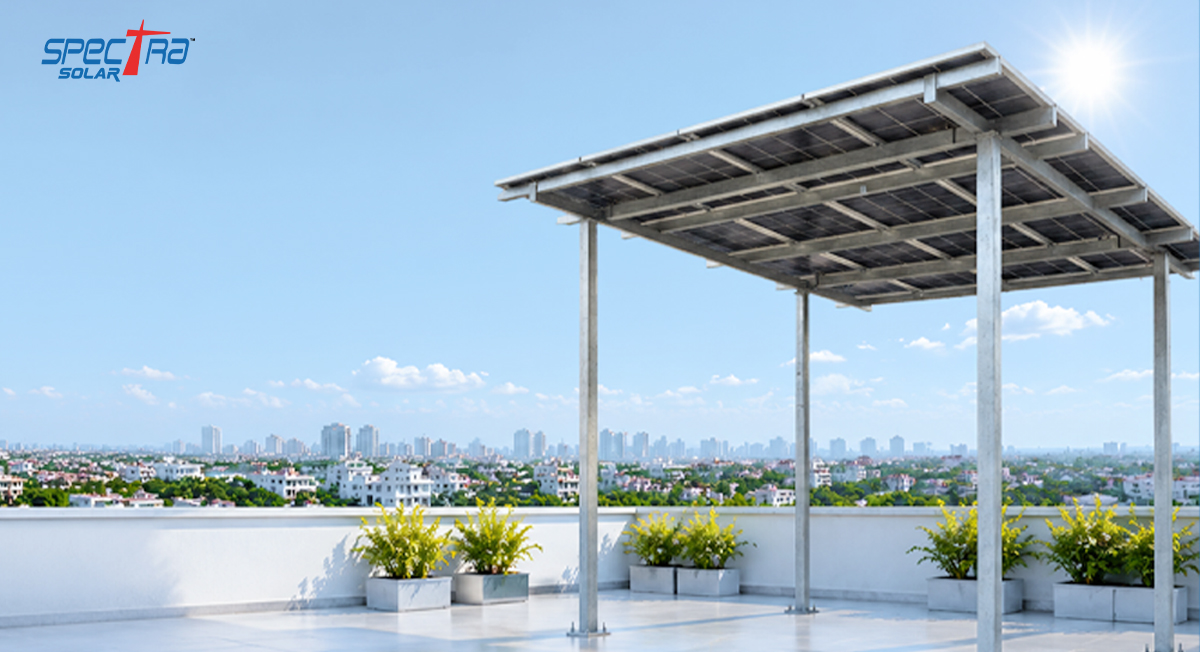
Installing a solar panel for residential properties is the most reliable way to break away from this cycle of rising utility costs. By turning your own flat roof space into an independent clean power source, setting up a custom rooftop solar system for your home in Faridabad lets you lower your monthly electricity overheads permanently.
This localised home solar panel installation guide for Faridabad bypasses generic industry talk to look directly at the specific spatial, environmental, and financial factors that affect your local property.
The Faridabad Roof Challenge: Navigating Builder Floor Layouts and Dust
Determining feasibility for a residential solar installation in Faridabad requires addressing real-world structural layouts that are entirely unique to the city. Unlike newer corporate hubs dominated by uniform high-rise complexes, Faridabad’s residential architecture presents two specific ground realities.
1. Shared Roof Rights and Spatial Footprints
If you live in a classic bungalow in Sector 14 or 15, mapping out system space is relatively straightforward. However, across the newer independent builder floors in Sector 21 or Sainik Colony, roofs are frequently shared or split among multiple owners.
-
The 100 Sq. Ft. Rule: A basic 1 kW setup needs a clear 10-by-10-foot patch. For a typical 3 kW home system, you will need about 300 square feet of open terrace.
-
Shadow Mapping: But square footage is only half the battle. You also have to dodge shadows from common rooftop obstacles like brick parapet walls, water tanks, and nearby trees. Tracking how the sun moves across your specific roof from mid-morning to late afternoon is essential. A single blocked module can drag down the performance of your entire system.
2. High Particulate Levels from Local Industrial Belts
Faridabad's nearby industrial belts bring a lot of airborne dust and soot over residential sectors. This fine grime settles on glass surfaces fast, blocking out sunlight.
If left uncleaned, this buildup can cut your power generation by 25% in less than a month. To protect your returns, look for monocrystalline modules with anti-soiling glass coatings that match the verified national testing standards. This slick surface keeps industrial soot from sticking, keeping production high between your weekly cleanings.
The Step-by-Step Engineering Journey to Grid Activation
Discovering how to install solar panels at a home in Faridabad involves navigating a precise technical and structural process. A professional installation moves through four distinct phases to ensure long-term safety and maximum energy generation.
-
Phase 1: Structural Load Inspection:- Engineers check your concrete roof slabs. For independent properties or shared builder floors with older masonry, calculating weight distribution ensures the structure can support the heavy metal frames and glass rows over time.
-
Phase 2: Racking and Wind-Resistant Anchoring:- The crew anchors the foundation. They bolt rust-resistant channels made of hot-dip galvanised iron or aluminium straight into the floor. Following a precise, step-by-step installation process ensures these frames are built tough to handle intense pre-monsoon dust storms and heavy downpours.
-
Phase 3: Module Interconnection and Routing:- Once the framework is locked down, the installers clamp the modules into place at a tilt angle optimised for the local sun. They route weather-proof cabling neatly along the edges of the house, keeping shared staircases and walkways completely clear.
-
Phase 4: Inverter Setup and Electrical Integration:- Finally, they mount the inverter on a shaded wall downstairs. Your panels produce raw Direct Current (DC), which standard home appliances cannot use. The inverter instantly translates this into stable Alternating Current (AC) electricity, feeding it straight into your main switchboard to power your home.
Local Economics: Navigating Subsidies and DHBVN Approvals
The overall financial return on your clean energy investment is supported by direct government incentives. Under the central PM Surya Ghar Muft Bijli Yojana, residential properties can claim a substantial solar panel subsidy for homeowners in Faridabad to lower their upfront out-of-pocket setup costs.
-
1 kW Capacity: Eligible for a direct subsidy of ₹30,000
-
2 kW Capacity: Eligible for a direct subsidy of ₹60,000
-
3 kW to 10 kW Capacity: Fixed at a maximum subsidy cap of ₹78,000
The 3 kW Efficiency Sweet Spot: Because the central solar subsidy framework caps its financial assistance at ₹78,000 for any solar system 3 kW or larger, a 3 kW configuration delivers the absolute fastest financial payback period for standard residential properties in Haryana.
How Net Metering Dictates Your Monthly Savings
Under Haryana’s electricity rules, the local power grid essentially acts as your free backup battery. On bright summer afternoons, your rooftop panels will produce a lot more electricity than your fans and air conditioners actually consume.
Instead of letting that extra power go to waste, your dual-route net meter sends it straight back into the public lines, spinning your electricity bill backwards. DHBVN records these extra units as energy credits on your monthly statement. If you run your AC all night, those daytime credits directly wipe out your nighttime consumption.
In Faridabad, these savings roll over automatically from month to month. At the end of the financial year in March, DHBVN tallies everything up for a final settlement, capping your total solar credits at 90% of what you imported from them over the year.
To ensure your applications move smoothly through your local DHBVN Sub-Divisional Office (SDO), partnering with an experienced provider recognised as the best solar EPC company in India is essential. Certified engineering teams directly manage the entire regulatory process, from initial structural feasibility checks and document filing to final net metering synchronisation.
Furthermore, because local industrial soot builds up quickly across Faridabad, scheduling regular health checkups and routine panel washing with your service provider is the only way to prevent long-term generation drops. Dedicated maintenance keeps your high-voltage connections safe and keeps your system performing at peak capacity for decades.
Industrial Scaling: Optimising Commercial Rooftops
This exact same financial logic applies directly to the expansive industrial sectors operating across the region. For manufacturing enterprises looking to optimise their operational overhead within the Sector 24 or Sector 25 industrial zones, deploying commercial rooftop systems turns massive, unutilised factory roofs into active, cost-cutting tools.
Setting up high-capacity solar panels for industries satisfies internal green mandates while entirely eliminating the expensive peak-load surcharges utilities enforce during heavy daytime production hours. Partnering with specialised commercial and industrial solar companies ensures your enterprise migrates to reliable rooftop solar for industries and commercial spaces smoothly and safely.
Take Control of Your Property's Energy Future
If you want to stop paying unpredictable monthly utility bills and are ready to see exactly how a custom clean energy system can fit onto your property's available roof space, team up with an engineering group that manages the entire transition from initial design to final grid activation.
Get in touch with the specialised installation team at Spectra Solar Power this week to book your comprehensive on-site rooftop scoping analysis, and claim absolute control over your household utility expenses.

Share This Article


Ready to switch to solar?
Get a free site assessment and no-obligation proposal within 48 hours. Our team covers 100+ cities across India.
-
 Plot No. 2, Landmark Tower, 2nd Floor, South City-1, Ashok Marg, Gurugram, 122001, Haryana
 -

-


