What is a 3-Phase Meter? Solar Types, Benefits & Wiring Explained

When planning for a solar panel for home installation, users need to understand the basic working of the entire electrical system to ensure that the installation is foolproof and free from any mishaps. This is especially important for larger properties with a higher electricity demand.
The power phase for your house should be selected based on the required power supply. For most houses, a single-phase power supply is enough. However, three-phase connections are the standard choice for installations at larger properties.
Let’s understand every aspect of 3-phase power, including what 3-phase meters are.
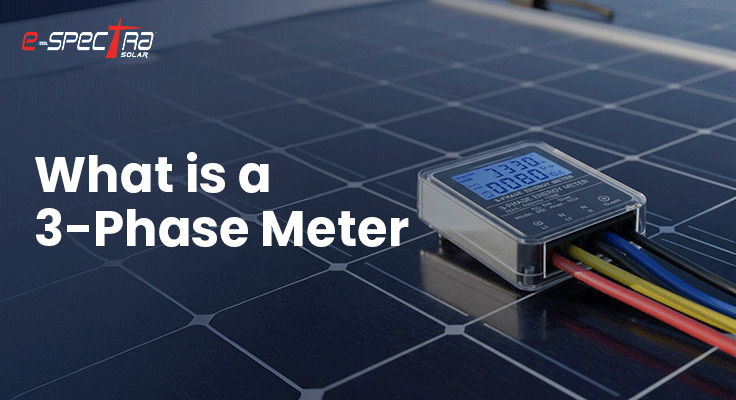
Breaking Down the Basics: What is a 3 Phase Meter?
Let’s take a real-world example of water flowing through pipes. The water inside the pipes is the current in your electrical system. The system uses a 3-phase meter to monitor voltage levels from three independent power sources and track the overall flow volume.
While a regular property source its power from a single alternating current line, larger installations at bigger properties require a 3-phase meter to monitor each power source aligned 120° from each other.
The setup is meant to ensure a steady power supply through a higher holding capacity. Large homeowners with a plan to install a solar panel for residential use must be aware that a system struggling to meet the power demand will cause the operational costs to rise. The meters serve the purpose by constantly keeping a check on the voltage from all three phases, keeping them balanced at all times.
How Does a 3 Phase Electric Meter Work for Solar Panel Systems?

Now we're getting to the good stuff. The moment you install solar panels, you're not only consuming electricity. You're generating it too. A 3-phase solar meter needs to measure power moving in both directions—electricity coming into your property from the grid and electricity heading back out when your panels produce more than you're using.
Current transformers sit on each of the three phases. Their job is to take those high currents and bring them down to levels the meter can safely measure. While that's happening, the meter's also taking voltage readings from each phase. It crunches all these numbers together, factors in something called the power factor, and figures out exactly how much energy you're consuming or producing at any given moment.
The really clever bit about how a 3-phase electric meter works for solar panel installations is the net calculation it performs. During those sunny afternoons when your panels are pumping out energy, the meter basically runs in reverse (digitally, anyway), banking credits for all that surplus power you're sending back to the grid.
This is directly related to what net metering is meant to do, using the billing system utilities to credit solar owners for the electricity they feed back into the grid.
When clouds roll in or evening arrives, the meter switches direction and tracks what you're pulling from the grid. Your electricity bill comes down to the gap between these two figures.
Types of 3 Phase Meters: Finding Your Match
The current industry standard for the types of 3-phase meters installed at sites mainly includes 4 varieties of meters. Each has a different technical mechanism, making them specific for specialised applications.
1. Electromechanical Meters
These are the old-school options. Their spinning disc and mechanical counter mechanism use electromagnetic induction to track voltage flow. Electromechanical meters are the most durable and reliable option among all the other varieties.
However, with technological innovation and advancement, these are gradually being phased out from being used in solar power units, as more accurate systems are needed to monitor the power generation.
2. Electronic Meters
These are what most residential and commercial solar setups use today. Each digital unit delivers precision that mechanical meters simply can't touch. Their electronic circuitry with microcontrollers is much more efficient at measuring the current and voltage. The data accuracy is ensured down to the microunit, with complete ability to tell the active and reactive power distinctions.
3. Smart Meters
Smart meters are designed to kick things up another notch. These connected devices do more than just measure—they talk. Using cellular networks, Wi-Fi, or power-line communication, smart 3-phase solar meters beam real-time information about your energy production and consumption straight to you and your utility provider.
Manual meter readings become obsolete. Each meter comes with a tracking application that can be installed on a smartphone. This kind of access to micro-level monitoring is ideal for users who are serious about significant power cost reduction.
4. Prepaid Meters
They work on an entirely different philosophy. They're common in certain markets and require you to buy electricity credits upfront. While they're less typical in residential solar applications, they're worth mentioning because some utilities provide specialised prepaid programs that integrate with solar installations, letting you track precisely how much grid power you're consuming versus generating.
Benefits of a 3 Phase Meter for Solar Systems: Beyond Basic Monitoring

Installing a proper 3-phase meter alongside your solar array delivers advantages that go way beyond simple power measurement. Load balancing becomes dramatically easier. Running heavy machinery, multiple air conditioning units, or other power-intensive equipment? Distributing that demand across three phases stops any single phase from getting swamped.
This particularly matters for commercial solar panels for residential complexes or large homes with workshops and dedicated office spaces.
To ensure maximum performance and lifespan of a solar system at such properties, the necessary metering configurations and monitoring systems must be put in place properly.
The financial picture is just as compelling. With accurate measurement happening across all three phases, you can spot consumption patterns that would otherwise slip past unnoticed. Maybe one phase consistently draws more power than the others, pointing to an imbalance that's bleeding money.
Or perhaps your solar production peaks during times when your consumption hits its lowest point, suggesting you should reschedule certain activities to maximise self-consumption instead of selling excess power back at reduced rates.
Working with solar panel maintenance services becomes significantly more effective when you've got detailed three-phase data available. Maintenance providers can dig into your meter data to catch declining performance in specific sections of your array, flag components that are starting to fail before they cause total shutdowns, and optimise your system configuration based on real usage patterns instead of theoretical guesswork.
Wiring Considerations: Getting the Technical Bits Right
To ensure optimum performance and safety of a solar system for a home, careful setup of the wiring configuration in a 3-phase solar meter is required. All three power lines must be consistently connected to the specific phases based on their colour code, i.e., blue, black, and red. Any connection errors might lead to wrong readings and maybe a short circuit, which would be detrimental to your entire system.
Another wire, called the earthing/neutral wire, is needed as a reference power line for the metering system to gauge the readings efficiently and channelise the unbalanced loads. This wire is necessary to eliminate any measurement disruptions that might cause billing errors.
Moreover, grounding wires work like an airbag, providing safety in times of an accidental power surge. Whenever there is a power surge that is overwhelming for the system, the excess voltage is transferred automatically to the neutral wire to prevent system overheating that may otherwise lead to circuit failures and damage to the equipment.
For every solar panel for home use, this is a prerequisite system mandate that needs to be executed for optimum safety of your solar system.
Making the Right Choice for Your Solar Investment
Selecting the right 3-phase meter for your solar installation goes beyond just comparing technical specifications. Start by checking your utility's requirements because they'll specify certain features and certifications your meter must carry. Then evaluate your monitoring needs. Do you want real-time data access, or will monthly readings work fine? Planning to expand your solar array somewhere down the line? You'll need a meter with higher capacity ratings to accommodate that growth.
Partnering with experienced installers like Spectra Solar Power with qualified solar panel maintenance services will ensure your metering solution meshes seamlessly with your overall system. we’ll weigh factors like your typical load profile, peak generation capacity, and local regulations to recommend the most suitable option. Keep in mind, this meter serves as your financial interface with the grid, so getting it right carries more weight than you might initially realise.

Share This Article


Ready to switch to solar?
Get a free site assessment and no-obligation proposal within 48 hours. Our team covers 100+ cities across India.
-
 Plot No. 2, Landmark Tower, 2nd Floor, South City-1, Ashok Marg, Gurugram, 122001, Haryana
 -

-

RELATED BLOGS