Seasonal Impact on Solar Panel Efficiency in India: Summer, Monsoon & Winter

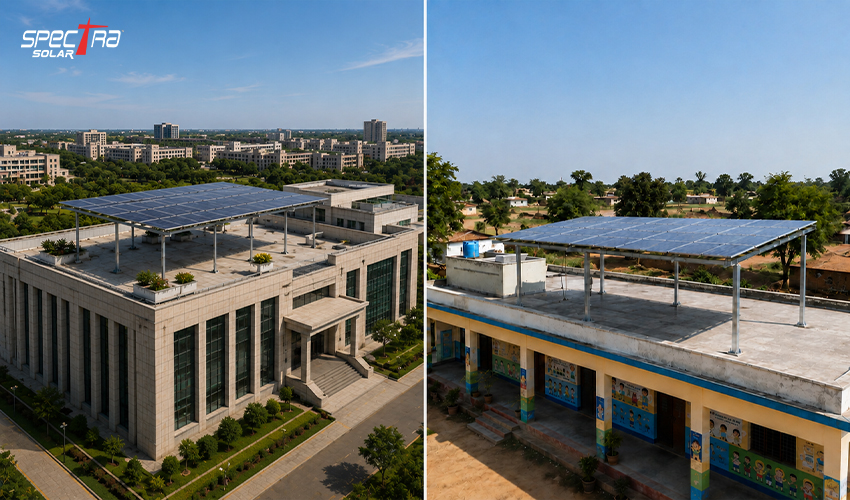
Across the vast landscape of India, a fundamental, decisive energy shift is unfolding. The sight of solar panels for home crowning residential rooftops has become a clear and compelling declaration by countless households seeking to claim autonomy over their power supply.
As a premier provider of sophisticated solar solutions and expert solar panel maintenance services, Spectra Solar Power routinely fields a critical, practical query from its clientele: How precisely do India’s three profoundly different climatic regimes, the searing summer, the relentless monsoon, and the mild solar panel efficiency in winter, influence the daily performance and lifetime output of a photovoltaic system?
The primary allure of solar technology lies in its perceived simplicity: a durable asset that effortlessly harnesses the sun’s energy. However, the reality of the seasonal effect on solar panels in India is intricate, demanding a deeper appreciation of environmental physics.
These pronounced annual climatic cycles act as the primary governors of the system’s total energy yield, directly dictating the eventual returns on your capital investment. Acquiring a comprehensive grasp of the unique ways each season engages with the photovoltaic technology is thus non-negotiable for ensuring consistent, peak operational effectiveness year after year.
Summer: Where Maximum Sunlight Meets a Technical Ceiling
When discussions pivot to peak solar energy production, the intense, drawn-out daylight of the Indian summer naturally monopolises attention. It is wholly reasonable to conclude that this time of year, with the sun at its most vertical point and longest duration, must represent the absolute high-water mark for generating power.
Indeed, when tallied in total monthly kilowatt-hours, this premise holds: the sheer volume and fierceness of solar irradiance ensure a massive cumulative energy capture. Yet, an immutable constraint rooted in the physics of silicon semiconductors introduces a key operational irony: the paradox of thermal degradation.
In spite of the undeniable brilliance of the pervasive sun, summer often marks the period when the photovoltaic cell is functioning at its poorest technical efficiency.
The Physics of Heat and Power Loss
Crystalline silicon PV cells are calibrated to convert sunlight into electricity most effectively when the operating cell temperature is kept near the industry standard of 25°C (77°F). On a typical Indian rooftop on a blazing afternoon, the panel’s dark surface, acting as a solar absorber, drives the internal cell temperature far beyond the ambient air, often pushing past 60°C and sometimes reaching 70°C in arid zones.
Empirical studies and live performance monitoring consistently demonstrate that once the cell temperature elevates above the 25°C threshold, the panel’s voltage potential begins to diminish. This inevitable thermal stress initiates a power output reduction, typically manifesting as a loss of between 0.25% and 0.5% of the system's nameplate capacity for each corresponding degree rise.
The subsequent voltage drop dramatically curbs the instantaneous solar panel efficiency in summer, meaning the unit is restrained from delivering its maximum potential rating, even when the illumination itself is optimal.
Performance Example: Consider a high-spec 400Wp module. Under the cool precision of laboratory conditions, it meets its rating. By 2:30 PM on a high-summer day, with the cell temperature spiking to 65°C, the resulting thermal derating translates to an output temporarily capped nearer to 330Wp.
Though the sheer volume of sunlight ensures a significant cumulative energy harvest throughout the day, the fundamental efficiency of the energy conversion process itself is markedly stifled by the oppressive heat.
For any family considering a solar panel for residential installation, addressing this thermal reality is critical to system longevity and output. Spectra Solar Power’s design protocol mandates superior mounting structures that incorporate generous air gaps and elevated positioning.
This strategic use of convection is a deceptively simple, yet powerful, defence against efficiency loss. For more details on system components, read our blog on Solar Inverter and Battery System for Residential Homes.
Monsoon: The Test of Light Penetration and Durability

The annual arrival of the monsoon brings welcome climatic relief but simultaneously imposes the most taxing conditions for maintaining consistent solar energy production. The primary limitations shift entirely away from thermal concerns and towards reduced solar intensity and high atmospheric turbidity.
The Obstruction of Cloud Opacity
The annual arrival of the monsoon provides necessary climatic relief but introduces the most taxing conditions for maintaining steady solar energy production. The operational limitations during this period shift entirely away from thermal concerns and focus instead on reduced solar intensity and increased atmospheric opacity.
The Suffocating Cloud Layer
With the commencement of the yearly rains, generally spanning July through September, the skies turn permanently grey, often congested by colossal, moisture-laden cloud formations. Solar energy capture is contingent upon a mix of both potent direct radiation (DNI) and the subtler, weaker light diffused throughout the ambient air.
This dense, unyielding curtain of clouds operates as a massive atmospheric impediment, severely constraining the quantity of high-intensity solar radiation that actually reaches the PV apparatus.
- Output Diminution: Although the solar panels unequivocally sustain generation, their operation relies primarily on this diffused illumination, which carries a substantially depleted energy concentration. The direct consequence is a marked drop in the daily electrical yield, often settling at merely 15% to 35% of the power realised on a perfect, cloudless day.
- Irregular Fluctuation: The rapid, erratic transit and continually varying density of these torrential monsoon clouds trigger sharp, significant turbulence in solar irradiance, creating volatility that starkly defines the compromised and lower solar panel performance in the Indian monsoon.
Dust Removal and Material Resilience
The dry, dusty pre-monsoon period facilitates the heavy accumulation of fine particulates, pollen, and aerosols on the panel glass. This superficial build-up, known as soiling, physically blocks light and can easily cost a system 5% to 15% of its generating capacity.
Thankfully, the intensity of the monsoon downpours provides an excellent, regular natural wash, scouring the panel surfaces and often producing an immediate, temporary boost in output. However, this intermittent benefit is generally outweighed by the persistent, overall low-light regime.
Moreover, the prolonged high-humidity environment necessitates top-tier component quality. Our selection process at Spectra Solar Power insists on using only PID-resistant and meticulously sealed modules, guaranteeing the system's structural integrity against moisture and the stresses of the regional climate.
Winter: Peak Efficiency’s Brief, Brilliant Showcase
For the astute solar system owner, the cool, crystal-clear days of the Indian winter season offer the most rewarding operational experience. Despite the inherent disadvantage of significantly shorter daylight hours, winter is, by all technical metrics, the time when your system achieves its absolute highest conversion rate, leading to superior solar panel efficiency in winter.
The Alignment of Optimal Conditions
The moderate temperatures and enhanced atmospheric clarity of winter create a triad of near-perfect conditions for PV operation:
- Controlled Temperature: The general coolness keeps the operating cell temperature much closer to the ideal 25°C range. This near-absence of thermal stress ensures maximal voltage output, allowing the panel to convert the highest possible percentage of incident solar energy.
- Atmospheric Purity: Following the season of rain, the atmosphere is largely purged of dust and pollution. This excellent clarity ensures that the direct solar radiation reaching the panels is at its cleanest and most intense, further bolstering conversion efficiency.
- Wavelength Advantage: The specific spectral composition of winter light, combined with the cool cell temperature, provides a minor, yet measurable, enhancement to the fundamental quantum efficiency of the silicon cells.
Differentiating Solar Panel Output Winter vs Summer: Rate Versus Total Energy
It is absolutely crucial to distinguish between the system’s instantaneous conversion rate (its technical efficiency) and the total energy harvested (the overall yield). Owing to the sun’s diminished angle and the significantly shorter available daylight hours, the aggregate energy units generated daily and monthly in winter are reliably and predictably lower compared to the summer period.
Production Context: The observed annual production curve for solar energy production summer monsoon winter places summers first in total energy (driven by sheer length of day), winter second (driven by high efficiency and light quality), and the monsoon third (limited by cloud cover). A well-designed system will typically show a 15% to 25% reduction in total kilowatt-hours produced in a month like December compared to a peak month like May, which is purely a function of fewer sun hours, not technical underperformance.
Consequently, when Spectra Solar Power engineers a custom system for a client, the design prioritises the overall annual energy requirement. The installation is precisely calibrated to shrewdly mediate the heightened solar panel efficiency in winter against the maximum exposure hours of the summer months, thereby ensuring that the resulting combined annual energy yield reliably satisfies the household's electricity needs.
Proactive Measures for Managing the Impact of Weather on Solar Panels

While the inherent variability of the Indian climate is a constant reality, its negative effects on your returns can be effectively contained and minimised through professional, systematic care. This principle underpins the absolute necessity of reliable solar panel maintenance services.
Maintenance as Continuous Optimisation
Maintenance must be viewed as an essential, year-round strategy for maximising energy harvest and securing asset longevity, moving well beyond the simple, reactive notion of 'cleaning.' It involves pre-emptive intervention tailored to the coming season’s specific threats. A core element of this is the rigorous preparation for the punishing wind and water of the monsoons.
-
Monsoon Fortification Protocol: Just ahead of the heavy rains, we dispatch our teams to conduct a comprehensive structural and electrical assessment, effectively treating the system to a pre-emptive weather-hardening procedure.
This critical step involves more than surface checks; we meticulously verify all mounting hardware for any signs of bolt loosening, manually confirm the tension across every wiring junction, and rigorously test the earthing system to ensure flawless conductivity.
This detailed sealing effort is executed expressly to fortify the system against high wind uplift and moisture penetration, thereby constructing an impermeable barrier that fully repels the insidious threat of ingress of humidity and water damage.
- Post-Monsoon Deep Cleaning: While the rain provides a superficial rinse, professional service is crucial post-monsoon to remove hardened mineral deposits, stubborn grime, or industrial film. This intensive cleaning is critical for restoring maximum light absorption just in time for the highly efficient winter months. To understand the common pitfalls of neglected systems, you may want to read our blog on Why Solar Panel Maintenance is Crucial.
- Summer Airflow Verification: We routinely confirm that the crucial air gap beneath the modules remains clear of debris or obstructions. This simple procedure aids natural convection, serving as a primary defence against the thermal losses that compromise solar panel efficiency in summer.
A scheduled, comprehensive maintenance agreement is the single strongest guarantee of your system's long-term health, protecting your investment and ensuring reliable performance through every climatic phase.
Conclusion: The Ultimate Metric is Total Annual Yield
India’s richly varied climate ensures that a solar system is a dynamic, constantly reacting asset. Homeowners should fully anticipate that their solar panel efficiency in different seasons will adhere to a consistent, well-defined sequence: maximum total energy yield in summer, the greatest conversion efficiency in winter, and diminished output during the cloud-dense monsoon.
The sole, most telling benchmark for judging a successful investment in solar panels for home remains the reliable, predictable Annual Energy Production. By choosing a committed provider such as Spectra Solar Power, you ensure your premium system is not merely installed by experts but is also continually maintained to yield maximum output despite all environmental fluctuations.
This unwavering focus on engineering excellence and client service guarantees a substantial total annual energy yield, which directly translates into significant, dependable financial savings and genuine energy self-sufficiency for years ahead. Embrace the natural passage of the sun, the rain, and the cool air your solar system is skilfully engineered to perform not just competently, but spectacularly, throughout every season, securing a cleaner, more independent future.

Share This Article


Ready to switch to solar?
Get a free site assessment and no-obligation proposal within 48 hours. Our team covers 100+ cities across India.
-
 Plot No. 2, Landmark Tower, 2nd Floor, South City-1, Ashok Marg, Gurugram, 122001, Haryana
 -

-

RELATED BLOGS